























If you are new to SEO, words like Domain Authority (DA) and Page Authority (PA) might seem hard. Many beginners worry about low scores and assume these numbers directly control Google rankings. However, DA and PA are tools created by Moz to help estimate ranking potential. At Digital Wit, we often see this misunderstanding when working with websites that are just starting their SEO journey.
They predict how well a site or page might rank. DA checks the whole website, while PA checks just one page. Although they are not direct ranking factors, good backlinks and strong content—often built through proven Off-Page SEO Techniques can help improve both scores over time. These metrics themselves do not change Google rankings on their own.
Domain Authority and Page Authority
This guide is for you if you are an SEO beginner, a blogger, or a small business owner who wants to improve your website’s SEO strategy. As a leading SEO agency in Bangladesh, we understand that newcomers often feel confused when they start learning about website authority metrics like Domain Authority and Page Authority.
You want simple, actionable ways to get better organic traffic and increase your search engine visibility. Understanding how these authority metrics work is a crucial first step toward building a stronger, more trustworthy website.
Overview and Origin of Authority Metrics
These scores, Domain Authority (DA) and Page Authority (PA), are special predictive metrics. They were created by a famous SEO company called Moz. These metrics try to guess how well a website or a specific page might rank in search engines.
They give you a helpful score to measure and track your site’s overall progress. We use them as strong indicators of a website’s strength and health.
Why Beginners Should Understand DA and PA
It is important to know that DA and PA are NOT direct Google Ranking Factors. This is a major misconception that confuses many beginners. Google uses its own secret algorithm to rank websites.
However, we still use these authority metrics because they are valuable indicators of overall SEO performance. They help us understand which websites are strong and which ones need improvement. Learning how to interpret DA and PA can also guide your planning for Off-Page SEO & Backlink Strategies, especially when building long-term authority and trust.
What Is Domain Authority (DA)?
Domain Authority or DA is a predictive metric that tries to guess the overall ranking strength of your whole site. It is one number that tells you how strong your website is compared to others in your niche. We can think of DA as the authority score of your entire brand on the internet. Beginners need to understand that this metric reflects the overall site credibility and trust.
How the DA Score Works
The DA score ranges from one to 100. One is the weakest and 100 is the strongest score. This scale is logarithmic, which means something important. It is much easier to increase your DA from 10 to 20 than it is to increase it from 60 to 70. You can use the simple analogy of a university’s reputation to understand DA. The university’s name and age give it authority.
Key Factors in Calculating DA
First of all Calculates your Domain Authority using many factors. The main factors look at your backlink quality and quantity. They count the number of unique Linking Root Domains that point to your whole site. Other important factors include your website’s Domain Age and its Spam Score. A high Spam Score can quickly lower your DA.
What Is Page Authority (PA)?
Page Authority or PA measures the ranking strength of just one single page or URL on your website. Where DA looks at the whole domain, PA focuses only on a specific page. Like DA, the PA score also uses a logarithmic scale from one to 100.
We can use the simple analogy of a single research paper to understand PA. If that paper gets a lot of citations, its authority score goes up, even if the university’s (DA) score is average.
Key Factors in Calculating PA
Calculates Page Authority based on factors directly linked to a specific page. One of the most important factors is the number and quality of page-specific backlinks. These are links coming from other websites directly to that one URL.
If you want a clearer understanding of What Are Backlinks & How Do They Work, this concept becomes much easier to grasp in real-world SEO scenarios.
The score also considers the strength of the internal linking the page receives from other pages on your own website. Finally, the on-page relevance of the content matters greatly for the PA score.
Understanding the PA Score
It is a common curiosity for beginners to ask why PA can sometimes be higher than DA. This happens when a specific page has received many high-quality backlinks, but the rest of the whole site is still very new or weak. This high score reflects the strength of that individual page rank. It shows that even a new site can have highly authoritative content on certain topics.
Key Differences Between DA and PA
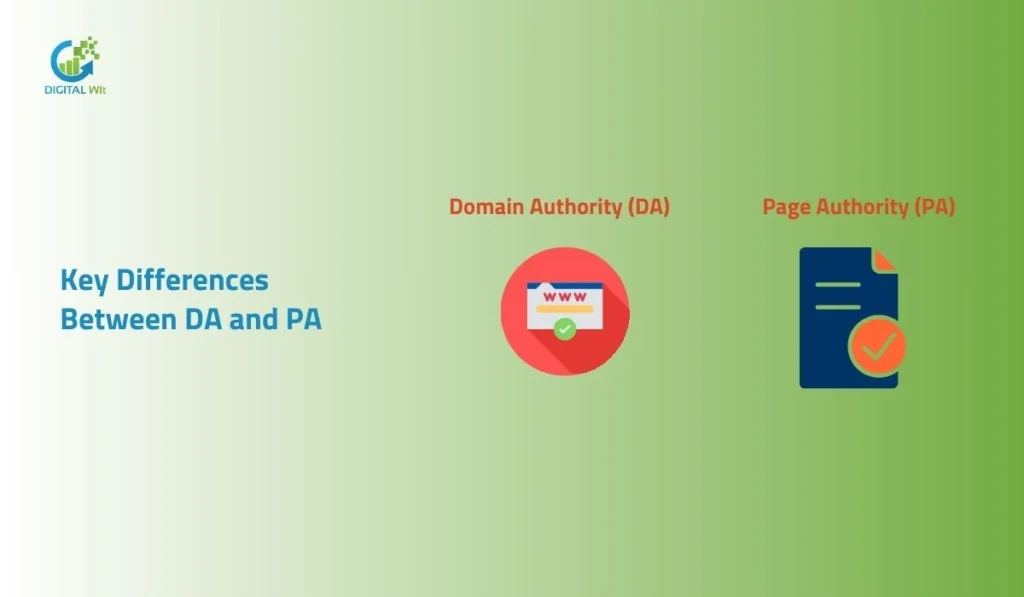
Beginners often ask what is the difference between DA and PA in SEO. The main difference is the fundamental scope of measurement. DA looks at the whole website, but PA only looks at one page. Understanding this scope difference is necessary for better SEO strategy. These two metrics move at different speeds of change, which is another important distinction.
Scope and Stability
The fundamental scope of DA is Domain-wide. It measures the entire domain’s strength, including all its pages and history. Because of this wide scope, DA is slower and more stable. It takes a long time and much effort to increase the score. In contrast, the scope of PA is Page-specific. Since it focuses on one URL, PA is more volatile and can change quickly after one good link is earned.
Growth and Comparison Points
Both scores follow the logarithmic scale. This means that when your DA or PA score is low, it is easy to gain points. However, getting from 80 to 90 is very difficult and needs a lot of effort. A key comparison point is when PA can exceed DA. This happens when a new website has one fantastic article that earns many high-quality backlinks very fast.
What Makes a Good DA and PA Score?
Many beginners worry too much about having a “low” score. It is important to know that there is no universal “good” score for DA and PA. These scores are of a relative nature. A DA of 30 might be excellent in a small, non-competitive niche. However, a DA of 30 would be very low in a highly competitive niche like health or finance. You must always compare your scores to your direct competitors who rank for your keywords.
Understanding Beginner Benchmarks
To help you set realistic expectations, here are some simple beginner benchmarks. New websites often start with a score lower than 20. Small, growing blogs that focus on quality content might aim for a DA between 30 and 50. Large, established authority sites often have scores of 60 or more. Use these ranges as a guide, but not as fixed rules for success.
Setting Actionable Goals
Your most important actionable goal is simple. You should aim to have a higher PA score than the specific pages currently ranking in the search engine results for your target keywords. If your competitor’s page ranking on page one has a PA of 45, then you must work to make your page’s PA higher than 45. This focus makes the metrics practical for daily SEO work.
Importance of DA and PA in SEO Strategy
DA and PA are important because they give us a way to measure success and plan an effective SEO Strategy. Even though they are not Google ranking factors, they are strong indicators of quality. We can use these metrics to understand our competitors and find good websites for acquiring links. This helps in enhancing your website’s Search Engine Visibility.
Using Metrics for Benchmarking and Audits
Competitive Benchmarking is one key use of these scores. You can check the DA of websites that are ranking above you and set better goals. Also, PA is useful for internal audits. By checking the PA of your own pages, you can easily find which pages need more help with internal linking or new content. This gives beginners a practical way to measure progress.
Link Building Prioritization
These metrics are most helpful in link building prioritization. When you are looking for websites to get a backlink from, you should always check their DA. A high DA score means the website has more credibility and a link from them will pass more authority to your site.
This process helps in evaluating site strength before you spend time reaching out to them. You can check these scores using many other Free Backlink Tools available online, which make it easier to identify high-quality link opportunities without spending money.
Practical Tactics to Boost DA and PA
Beginners always want to know how to increase DA and PA because they believe these scores are helpful for ranking. While they do not directly rank your site, improving them shows you are doing the right things for Google. The key is to use different SEO strategies to lift each score. We will discuss easy, doable steps you can start today to improve both.
Tactics for DA Improvement (Long-Term)
Since Domain Authority is about the whole site, you need long-term actions. The most important action is securing Strategic Backlinks from sites with high DA. You can achieve this through quality Guest Posting on relevant websites.
Also, you must regularly perform toxic link audits to remove bad backlinks that might pull your score down. A focus on Technical SEO improvements, like site speed, also helps the overall domain strength.
Tactics for PA Improvement (Targeted)
Page Authority is faster to improve because it focuses on a single page. Start with high-quality content creation and update old content regularly to keep it fresh. Ensure excellent on-page optimization for your target keyword on that page. Most importantly, build strong internal linking by linking to this page from other high-authority pages on your own website. To further enhance your Page Authority, it’s also essential to Build Quality Backlinks from reputable sources relevant to your niche.
Common Misconceptions, Mistakes, and Final Thoughts
We have learned that DA and PA are powerful tools for analysis, but they must be used carefully. Many beginners make simple mistakes that slow their progress. It is important to know which common myths to avoid so you can focus on what truly improves your website. Do not let these metrics cause unnecessary confusion or distraction from your main goal.
Myths and Common Beginner Mistakes
A big mistake is over-reliance on metrics. Some people spend too much time just chasing arbitrary scores instead of creating good content. Remember that DA and PA are not direct Google ranking signals. Google ranks sites based on user satisfaction and value.
Beginners must never ignore content relevance and excellent user experience (UX). Another mistake is buying links, which can lead to penalties and damage your scores.
Final Recap and Next Steps
We have resolved the confusion about PA > DA by showing it is possible for a strong page on a new site. Remember the logarithmic scale means you should not expect quick jumps in your score. For your next steps for SEO beginners, focus on creating high-quality content that people want to link to. Use DA and PA as best practices to monitor your progress against your competitors.
Frequently Asked Questions (FAQ)
What is guest posting?
Guest posting is a way to write an article for another person’s website. You include a link back to your own website in that article. This method is a very effective way to earn high-quality, relevant backlinks. It helps to increase your Domain Authority over time.
What is the difference between DA and PA in SEO?
The difference is in their scope of measurement. Domain Authority or DA looks at the ranking strength of your whole site. Page Authority or PA looks at the ranking strength of a single, specific page or URL. DA is slower to change, while PA can be more volatile.
How much DA PA is good?
There is no fixed score that is good for everyone. The score is relative and depends on your niche. A score is considered good if it is higher than the scores of your direct competitors. Most new websites start below 20, and established authority sites are often 60 or more.
What is a Domain Authority checker?
A Domain Authority checker is an online tool that you use to find the DA and PA scores of any website. These tools analyze a website using Moz’s algorithm. They help you to quickly see the strength of your own site or your competitors’ sites.
What is DA and PA in SEO?
DA and PA are predictive metrics used in SEO. They are scores from Moz that help you guess how well a website or page might rank in search engines. We use them for competitive analysis and to guide our link building strategy. They are not direct Google ranking factors.
What is Domain authority meaning?
Domain Authority means the overall strength and credibility of your entire website on the internet. It is a single, important number that shows how much trust your website has built up. It is determined by the quality and number of unique sites linking to you.
How to increase domain authority?
To increase your Domain Authority, you must consistently focus on earning high-quality backlinks from relevant, strong websites. You should also regularly audit and remove any toxic or harmful backlinks. Improving your technical SEO, like site speed and structure, also supports long-term DA growth.
Conclusion
We have clearly learned that DA measures the whole site for long-term growth. In contrast, PA is for a single page and requires targeted optimization. These scores act as useful benchmarks and indicators of your SEO health.
Remember that high scores are a result of good work, not the goal itself. For all SEO beginners, your most important actionable next step is to consistently focus on creating quality content and earning relevant link building. If you need expert guidance to implement these strategies effectively, Digital Wit can help as a trusted SEO partner with proven results.