






















Off-page SEO is the work that builds a site’s reputation beyond its own pages. It includes earning relevant backlinks, developing brand mentions, building local citations, encouraging genuine reviews, and promoting useful content. These signals can support discovery and trust, but they work best when the underlying content and technical SEO are already sound. Start with what backlinks are and how they work, then use the techniques below to build authority safely.
Overview of Off-Page SEO
We often hear about Off-Page SEO in digital marketing. This is the work done outside your website to improve its search ranking. It tells search engines that others trust your site. This trust helps your site move up in search results. It is a critical part of a complete SEO strategy.
What Is Off-Page SEO?
Off-Page SEO includes all actions taken away from your own website. These actions directly impact your search engine ranking. The main goal is to increase your website’s authority and relevance. This includes gaining Backlinks, getting Brand Mentions, and securing Citations.
Why Off-Page SEO Matters in 2026
The internet changes quickly, but off-page SEO remains useful in 2026 because search engines evaluate relevance, reputation, and the quality of external references. Links and mentions can help systems discover and contextualize a brand, but they do not replace helpful content, technical accessibility, or a good user experience.
Off-Page SEO vs. On-Page SEO vs. Technical SEO
It is important to understand the differences between the types of SEO. On-Page SEO focuses on optimizing the content and code on your website. Technical SEO ensures the website structure is easily crawlable by search engines. Off-Page SEO focuses on external signals like Backlinks and Authority. All three work together for the best SEO Ranking.
Why Off-Page SEO Is Important
Many website owners ask, “Why do I need to worry about Off-Page SEO?” The answer is simple. Even the best content will struggle to rank without external trust. Off-Page SEO & backlink strategies provide the authority signals that help search engines recognize your site as credible and boost your rankings over time.
Links and Mentions Influence Rankings
Every Backlink you get is like a vote of confidence for your website. Search engines use these links to decide how credible your page is. Similarly, frequent Brand Mentions, even without a direct link, show that your brand is important and recognized. This external validation is a major ranking factor.
Influences Domain and Page Authority
Tools report metrics such as Domain Authority (DA) and Domain Rating (DR) to help compare link profiles. These are not Google ranking factors, and a high score does not automatically make a link valuable. Relevance, editorial context, organic visibility, and audience fit matter more; see our DA vs. PA guide for context.
Improves E-E-A-T (Experience, Expertise, Authoritativeness, Trustworthiness)
Google’s E-E-A-T guidelines emphasize that content must be created by credible experts. Off-Page SEO directly addresses this. Links from established Authority Sites and positive Customer Reviews show expertise. This external validation confirms that your website is a trustworthy source.
Builds Online Reputation and Trust
A strong Backlink Profile and positive Brand Mentions build a solid Online Reputation. This trust is essential for users and search engines. When people see that major industry sources link to you, they trust your content more. This trust is the foundation of long-term success.
Increases Organic Traffic
When your website ranks higher due to great Off-Page SEO Techniques, you get more clicks. This increased visibility leads to higher Referral Traffic from authoritative sources. Ultimately, it results in a huge increase in Organic Traffic from search engines.
Key Components of Off-Page SEO
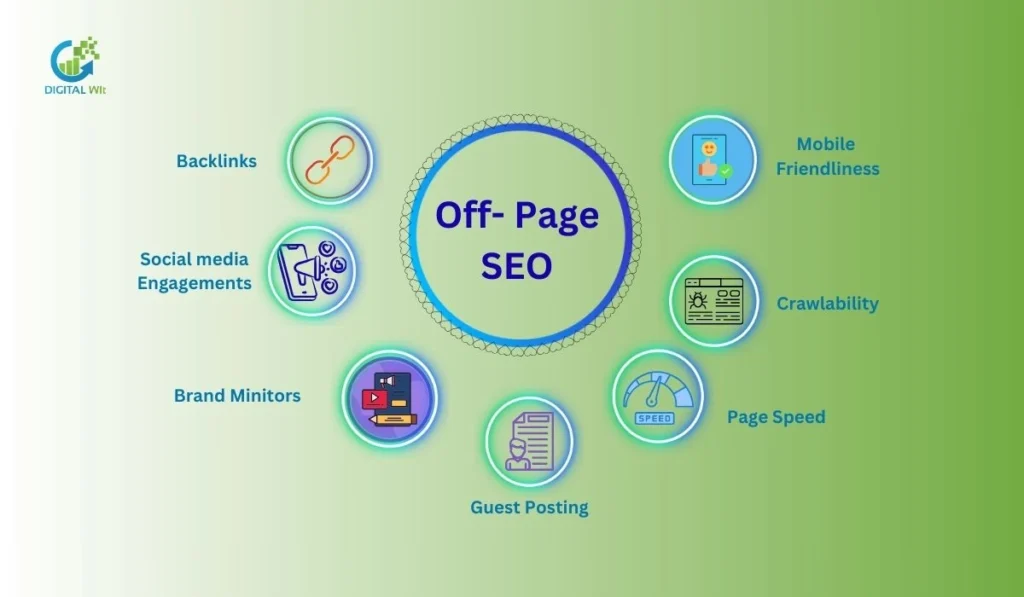
Off-Page SEO is a combination of different activities. It is not just about getting links, but building a holistic external presence. Understanding these components helps you build a strong Link Building Strategy.
Link Building
This is the process of actively acquiring high-quality backlinks. For those new to SEO, understanding what backlinks are and why they matter is essential, as link building remains the most crucial component of off-page SEO. A strong backlink profile is the primary driver of website authority and PageRank.
Social Signals
These include shares, likes, and comments your content receives on social platforms. While not a direct ranking factor, strong Social Media Shares indicate popularity and relevance. This helps with brand visibility and increases the chances of earning natural Backlinks.
Brand Mentions and Citations
This refers to instances where your brand name is mentioned online. Citations are often used in Local SEO to list your business information. Even Unlinked Brand Mentions (where your brand name is mentioned without a link) count as authority signals.
Entity Recognition and AI Trust Signals
Modern search engines recognize brands and topics as ‘entities’. Consistent, positive external signals help AI understand your brand identity. This process builds essential AI Trust Signals needed for future search visibility.
Content Marketing
Though content creation is On-Page SEO, its promotion is Off-Page. Creating Long-Form, Original, and Shareable Content is the foundation for earning Backlinks naturally.
Reviews and Testimonials
Positive Customer Reviews on platforms like Google Business Profile or Yelp are powerful Off-Page signals. They build credibility and directly impact E-E-A-T.
Essential Link Building Techniques
The biggest pain point for site owners is the high effort required for link building. To overcome this, it’s essential to focus on effective, high-quality methods that deliver the best ROI. A well-planned approach to building quality backlinks is the foundation of any successful link-building strategy and helps improve long-term search visibility.
Understanding Link Quality vs. Quantity
It is always better to get one High-Quality link than fifty low-quality ones. We must avoid low-quality Off-Page Submission Sites. The quality of the Referring Domains is what truly matters.
Relevance to Your Niche
A link from a website talking about the same topic as yours is highly valuable. Relevance ensures that the link contextually makes sense.
Authority of the Linking Domain (DA/DR)
Always check the Domain Authority (DR) of the target site using tools. A link from a site with a DR of 70 is much more powerful than a link from a site with a DR of 10.
Contextual Placement
A link placed within the main body of a relevant article has more value. Avoid links in footers or sidebars.
Anchor Text Diversity
The clickable text of the link is the Anchor Text. It should be natural, varied, and not overly keyword-focused.
Link Attributes (Dofollow vs. Nofollow/Sponsored/UGC)
Links may be followed, nofollow, sponsored, or user-generated depending on how they were earned and marked. Nofollow and sponsored links can still bring referral traffic and brand visibility, while paid placements should be labeled clearly.
Guest Blogging and Contributing to Authority Sites
Guest Posting means writing an article for another website. This is a crucial technique for earning links. Target Authority Sites that are relevant to your niche.
Broken Link Building Technique
This strategy involves finding broken external links (404 errors) on a target site. You then propose your similar content as a replacement. This is an efficient way to earn high-value Backlinks.
The Skyscraper Technique
You find the best-performing piece of content on a topic. You create something significantly better and more detailed. Then you perform outreach to people who linked to the original, asking them to link to your superior content instead.
Resource Page Link Building
Many websites have pages listing useful resources. You can offer your guide or recommend free backlink analysis tools to be included on these pages, especially if they genuinely help their audience. This is a focused type of outreach that often results in niche-relevant backlinks without feeling forced or promotional.
Digital PR and Press Releases
Digital PR is about earning media coverage, which results in links. This is a modern, scaled-up link-building method. Press Releases can be used strategically to announce truly newsworthy events.
Reclaiming Unlinked Brand Mentions
When someone mentions your brand but forgets to link to you, you have an Unlinked Brand Mention. Simple Outreach can turn these mentions into valuable Backlinks.
HARO (Help a Reporter Out) for Expert Citations
By responding to journalist requests on platforms like HARO, you can provide expert input. This often results in a mention and a Backlink from a high-authority news site.
Earning Links Through Original Research and Data Studies
Creating First-Party Research and Data-Driven Content makes your site a primary source. Other websites will naturally link to your findings to support their own articles. This provides powerful Editorial Backlinks.
Content Marketing for Off-Page SEO

Content Marketing is the fuel for your Off-Page SEO Techniques. Without great content, no one will link to you.
Creating Link-Worthy Content (Guides, Infographics, Tools)
The content you create must solve a problem or be highly educational. Infographics and interactive Tools are excellent Linkable Assets. They are easy to share and cite.
First-Party Research and Data-Driven Content
Content based on your own unique data is irreplaceable. This kind of Long-Form, Original, and Shareable Content naturally earns high-value Backlinks as journalists and bloggers look for citable sources.
Repurposing Content Across Multiple Platforms
Take a long guide and turn it into a Webinar or a series of social media images. Content Syndication on platforms like Medium and LinkedIn extends your reach. This helps you get more eyes on your content and increase Social Media Shares.
High-Quality Content Promotion (Quora, Reddit, Medium, LinkedIn, Pinterest)
Do not just publish content; promote it actively. Participate in relevant threads on Quora and Reddit, offering your content as a helpful resource. This is an effective way to drive Referral Traffic.
Building Brand Authority and Trust Signals
Off-Page SEO today is about building your brand’s trust. This is essential for improving E-E-A-T.
Tracking and Reclaiming Unlinked Brand Mentions: Set up alerts to monitor every time your brand is mentioned. If it is unlinked, reach out politely to secure the Backlink. This strengthens your Brand Signals.
Brand Citations and Co-Citations: Ensure your brand name and key information are consistently listed across the web. These consistent Citations help search engines correctly identify your entity.
Online Reputation Management (ORM): Your online reputation is directly linked to your authority.
Encouraging and Monitoring Customer Reviews: Ask satisfied customers to leave Customer Reviews on relevant platforms. High volume of positive reviews builds immense trust.
Responding to Reviews (Positive and Negative): Always respond professionally to all reviews. This shows customers and search engines that your brand is active and cares.
Thought Leadership and Expert Contributions: Your brand should actively demonstrate expertise. Having a dedicated voice and Clear Author Attribution on your content contributes to E-E-A-T.
Social Media Marketing and Community Engagement
While social signals are not direct ranking factors, they play a huge role in visibility and brand growth.
Leveraging Social Platforms for Brand Visibility
Use social platforms to maximize the reach of your Long-Form Content. This increases Social Media Shares and drives Referral Traffic.
Active Participation in Niche Forums (Reddit, Quora)
Engage genuinely on Forums like Reddit and Quora. Answer user questions thoroughly without spamming links. This builds organic authority and drives relevant traffic.
Influencer Marketing and Partnerships
Partnering with industry influencers can amplify your brand’s reach and credibility. Strategic collaborations and co-created content often result in valuable backlinks and wider audience engagement.
Collaborating with Industry Influencers: Work with Influencer Marketing experts for product endorsements or joint content creation. Their endorsement passes a strong Brand Signal to your business.
Building Strategic Brand Partnerships: Look for non-competing brands to create co-branded Webinars or Case Studies. This strengthens your reputation and can lead to valuable Backlinks.
Podcasting and Webinars
Hosting or appearing on industry podcasts positions your brand as a thought leader. Educational webinars showcase expertise and often generate valuable backlinks and brand mentions.
Starting or Appearing on Industry Podcasts
Being a guest expert on a Podcasting show positions you as a thought leader. It results in Brand Mentions and often a Backlink from the podcast website.
Hosting Educational Webinars
Hosting your own Webinars allows you to showcase expertise and capture leads. They also provide great content to repurpose for social media.
Local SEO Off-Page Techniques
Local SEO Off-Page techniques help your business get noticed in your community. Optimizing citations, reviews, and local backlinks boosts visibility in local search results.
Google Business Profile (GBP) Optimization
Google Business Profile (GBP) Optimization: Your Google Business Profile is the most important local asset. Ensure it is fully optimized with accurate information and photos.
Local Citations and NAP Consistency: Your business’s Name, Address, and Phone number (NAP) must be identical across all listings. Citation Building and Directory Submissions must be handled carefully to maintain this consistency.
Advanced Off-Page SEO Techniques
Take your Off-Page SEO to the next level with advanced strategies like AI-driven link building, digital PR, and generative AI citations. These techniques help boost authority, visibility, and long-term search performance.
AI-Enhanced Link Building and Outreach
Use AI tools to analyze which types of Outreach emails are most effective. This increases your success rate and helps Scaling Outreach efforts, solving a major pain point.
Optimizing for Generative AI Citations
As search results become more AI-driven, optimize your content to be a primary source for AI answers. This results in AI Visibility Metrics—tracking brand mentions in generative results.
Auditing and Planning Your Off-Page SEO Efforts
You cannot improve what you do not measure. Regular audits are key to avoiding the Risk of Penalties.
Conducting a Backlink Audit
Use tools like Ahrefs or SEMrush to perform a full Backlink Audit. Look at your Referring Domains and Anchor Text profile.
Analyzing Key Metrics (Domain Authority, Referring Domains, Toxicity Score)
Focus on the overall health of your links by evaluating key metrics, including the difference between Domain Authority and Page Authority, the number of referring domains, and the toxicity score. This helps identify any potential toxic links that could negatively impact your search rankings.
Analyzing Competitor Backlink Profiles
Perform Competitor Analysis to identify where your successful competitors get their links. This reveals easy link opportunities for you.
Disavowing Toxic and Spammy Backlinks
If you find dangerous links, you must tell Google to ignore them using the disavow tool. This is a vital step in mitigating the Risk of Penalties.
Best Practices for Off-Page SEO Success
Successful Off-Page SEO Techniques require a white-hat mindset and clear planning.
Setting Concrete Goals and KPIs
Define clear Key Performance Indicators (KPIs) like monthly increase in Referring Domains or improvement in Domain Authority. Track these to measure Measuring ROI/Success.
Building Relationships Over Transactional Links
Focus your Outreach on creating genuine long-term relationships with Authority Sites. This is more reliable than one-time link exchanges.
Quality Beats Quantity
Always remember that one relevant, high-authority link is better than fifty irrelevant ones. This saves you from wasting time on low-value Off-Page Activities.
Low-Quality Off-Page SEO Techniques to Avoid
Never try to buy or sell links or join Private Blog Networks (PBNs). These are considered Black Hat SEO and will cause Google to give your website a penalty.
You must avoid spamming comments on blogs or engaging in massive, unnatural link exchanges, as these do not provide value. Focus only on earning High-Quality links to keep your Backlink Profile safe and strong.
- Avoid these tactics to prevent Google penalties.
How to Avoid Google Penalties for Unnatural Links: Google penalizes websites that try to manipulate its algorithm. Never engage in link buying or selling.
Private Blog Networks (PBNs): These are networks of websites created just to link to one site. They are explicitly against Google’s guidelines and will result in a penalty.
Link Exchange and Spam Comments: Unnatural reciprocal Link Exchange and spamming comments on Forums or blogs are useless and risky.
Measuring Off-Page SEO Success
Measuring Off-Page SEO Success means tracking metrics that show how your external efforts are helping your website. You must track growth in your Domain Authority and the number of new High-Quality Referring Domains. These key metrics help you understand the Return on Investment (ROI) from your Link Building Strategy.
- Reliable measurement helps justify the effort and investment.
Key Metrics to Track
Domain Authority and Page Authority: Track these scores regularly to see the impact of your link building.
Referring Domains and Backlink Growth: Focus on the number of unique Referring Domains, not just the total number of links.
Referral Traffic from External Sources: See how much traffic you get directly from your new Backlinks.
Tools for Monitoring Off-Page SEO Performance
Use reliable tools like Ahrefs, Semrush, or Moz Pro for analysis and tracking.
Off-Page SEO Trends for 2025 and Beyond
The future of Off-Page SEO is shifting from simple link acquisition to comprehensive brand building that satisfies AI search models. A primary focus will be on Generative Engine Optimization (GEO), ensuring content is clear, authoritative, and structured for citation within AI Overviews.
Building E-E-A-T through expert contributions, authentic reviews, and consistent brand mentions will be more crucial than ever for visibility in a post-traditional-link search environment.
The Rise of AI and Machine Learning in SEO
AI is getting better at identifying high-quality, natural links and Brand Mentions. This makes White-Hat Techniques more important than ever.
Beyond Links: Building a Recognizable Brand
The future of Off-Page SEO is holistic. It is about building trust and authority across all platforms, not just link building.
Off-Page SEO Case Studies
Successful Off-Page SEO Techniques often involve clever Digital PR and relentless Outreach. For example, a startup used HARO consistently for six months and saw its Domain Authority jump from 15 to 40, tripling its organic traffic.
Frequently Asked Questions (FAQs)
What are Off-page SEO types
Off-page SEO types include link building, brand mentions, social signals, citations, and content marketing outside your site.
Why off-page SEO is important
Off-page SEO is important because it builds trust, authority, and better rankings in search engines like Google.
Why should you use off-page SEO techniques in digital marketing?
You should use off-page SEO techniques in digital marketing to increase website traffic, build brand trust, and improve search visibility.
What are the best techniques for off-page SEO?
The best techniques for off-page SEO are guest posting, digital PR, broken link building, and earning brand mentions.
What is the best way to increase page rank using off page seo techniques?
The best way to increase page rank is by earning high-quality backlinks from authority sites through valuable content and outreach.
Conclusion
Off-Page SEO techniques are essential for taking your website to the top. Focus on earning high-quality backlinks and building genuine brand authority through trusted resources like Digital Wit, while following proven processes used by a leadings SEO agency in Bangladesh.
Start with a competitor analysis, prioritize guest posting, and manage your online reputation effectively. Use this guide as your permanent Off-Page SEO checklist to achieve lasting SEO ranking success. On-page SEO still matters a lot for strengthening domain authority and trust.