























Customer service is changing fast. Companies are moving from old call centers to smart digital helpers. These helpers are called AI agents. They’re changing how businesses talk to customers and handle support.
This isn’t just basic automation. It’s about making every customer interaction fast, smart, and consistent.
Key Takeaways
- AI agents provide 24/7 customer support without breaks or holidays
- They handle thousands of conversations at once, eliminating wait times
- AI reduces costs while improving service speed and consistency
- These systems use language understanding to figure out what customers need
- AI works best when paired with humans for complex problems
- Chatbots, voice assistants, and email responders are common types
- Integration with business systems makes AI agents truly powerful
- Good data quality is essential for AI to work well
- Privacy and ethics must be carefully managed
- The future is human-AI partnership, not full automation
How Customer Service Changed Over Time
Customer service went through several stages over the decades. First, people talked face-to-face in stores and offices. Then call centers appeared as a major breakthrough.
After that came email and web forms for digital support. The problem? All these methods relied heavily on human workers.
This made service expensive. It was hard to handle busy times. And quality wasn’t always the same.
AI automation fixes these problems. It handles boring, repetitive tasks. This shift means businesses can now solve customer issues instantly and at large scale.
Why AI Agents Matter Today
Customers today have zero patience for slow service. They want help 24/7 on any device they use. They want answers right away on any channel they choose.
AI agents solve these demands. Here’s how:
Always Available: They provide support even outside business hours
Fast and Efficient: They handle thousands of questions at once
Always Consistent: They give the same quality answer every time
AI agents handle simple questions. This frees up human workers to focus on complex problems that need human touch.
How AI Agents Actually Work
AI agents use smart technology to understand and respond to people in real time. They’re not simple scripts following basic rules. They use advanced tools to act like intelligent assistants.
Understanding Human Language
Two key technologies power AI agents and make them work effectively. These systems help computers read and understand what people really mean.
Natural Language Processing (NLP) helps computers read and analyze human language. It breaks down sentences and finds patterns.
Natural Language Understanding (NLU) figures out what the customer actually means. For example, if someone types “I can’t log in,” the system knows they need help with login problems.
Learning From Past Conversations
AI agents aren’t programmed with every answer upfront. They learn from huge amounts of past customer conversations and support interactions.
Machine Learning models map customer questions to the right answers. Deep Learning models use complex patterns to create natural, helpful responses. The more data they see, the better they get.
Reading Customer Emotions
Good customer service means understanding how someone feels during the interaction. AI agents can detect if a customer is happy, neutral, or frustrated.
When the system spots negative emotions, it can put the query at the top of the queue, send it to a human supervisor faster, or use a more caring response. This ensures angry or frustrated customers get handled with care.
Daily Tasks AI Agents Handle
AI agents do several important jobs every single day in customer service. These tasks form the foundation of automated support.
First Response: They greet customers and figure out what they need
Collecting Information: They gather details like account numbers before passing to humans
Being Proactive: They warn customers about problems before customers even ask
By handling these basic tasks, AI agents work like efficient gatekeepers.
Different Types of Customer Service AI Agents
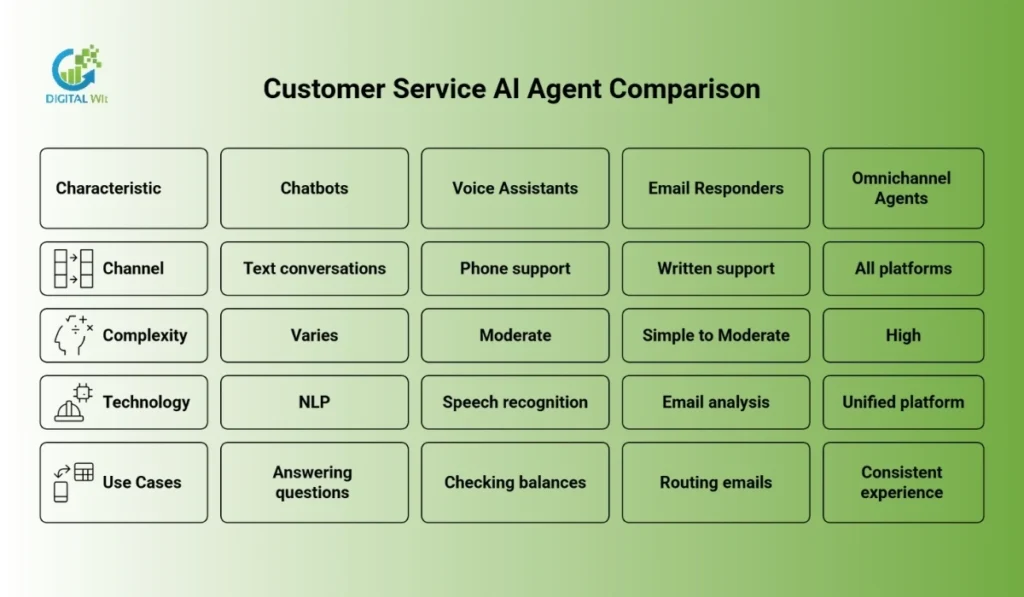
There are different types of AI agents for various needs. Each handles specific channels and complexity levels in customer service.
Chatbots for Text Conversations
These are the most common type you’ll encounter online. They come in three different types with varying capabilities.
Rule-Based Chatbots follow rigid scripts. They work for simple questions but fail when customers go off-script.
Smart Chatbots use advanced language understanding. They handle flexible conversations and work much better than rule-based ones.
LLM-Based Chatbots use the latest AI. They create completely new, natural responses. They feel almost human.
Voice Assistants for Phone Support
These handle interactions over the phone or through smart speakers. They combine understanding with speech technology.
They turn speech into text, understand what’s needed, and speak answers back. Companies use them for checking balances, resetting passwords, or looking up orders.
Email Responders for Written Support
Email remains a critical support channel for many customers. AI Email Responders automate this process efficiently.
They analyze the incoming email to understand the topic, route the email to the correct department, and for simple queries, automatically write complete responses. This cuts response time from hours to seconds.
Omnichannel Agents Across All Platforms
These work across all channels where customers interact with businesses. They remember conversations as customers switch from app to website to email.
No one has to repeat themselves or start over. This creates a smooth experience across every touchpoint.
Agent Assist Tools for Human Workers
These help human workers instead of talking to customers directly. They work as AI co-pilots for customer service representatives.
They suggest helpful articles during conversations, summarize what happened before the human took over, and alert workers when customers get upset. This makes human agents more effective and productive.
Connecting Everything in Your Business
AI agents work best when connected to all business systems. This integration turns them from simple chat tools into powerful automation engines.
Working Across All Customer Channels
Modern AI agents must work everywhere customers interact with your business. This includes websites, mobile apps, email, and social media platforms.
The key is keeping context. If a customer starts on website chat and continues via email, the system remembers. The customer doesn’t repeat themselves.
Connecting to Core Business Systems
AI agents need access to your important business systems to do useful work. For an AI agent to handle real transactions, it requires deep integration.
CRM Systems like Salesforce pull up customer history and do account-specific tasks.
ERP Systems check inventory, verify payments, or start refunds.
Ticketing Systems like Zendesk create support tickets with all the information already filled in.
Smart Routing to the Right Person
AI agents work like intelligent sorting systems for customer questions. They figure out where each question should go based on several factors.
Type of problem (billing vs. technical), how urgent it is, and how valuable the customer is all play a role. This gets the right person working on the right problem fast.
Workflow Automation for Faster Processing
Beyond routing, AI triggers automatic actions in your business systems. When a customer confirms an address change, the system updates it instantly.
No manual work needed. This creates true process automation that saves time and prevents errors.
Key Benefits for Business and Customers
AI agents deliver real value to businesses and customers alike. These benefits transform how companies provide support and how customers receive help.
Always Available Around the Clock
AI agents work 24/7/365 without breaks or holidays. They never need sleep or time off for any reason.
Customers get instant responses anytime, anywhere. This matters because customer problems don’t follow business hours.
No More Waiting on Hold
Waiting on hold is one of the biggest frustrations in customer service. AI agents handle many conversations at once without any delays.
For simple tasks, problems get solved immediately. The time from question to answer drops to seconds instead of minutes or hours.
Handle Any Volume of Requests
During busy times, human teams can’t scale quickly enough. AI agents handle thousands of extra questions without any drop in quality or speed.
Product launches, system outages, or holiday rushes don’t overwhelm the system. The service stays consistent no matter what.
Lower Operational Costs Overall
AI interactions cost much less than human ones for routine tasks. This lets businesses save money while improving service quality.
The savings can go toward hiring specialists for complex problems or improving products. It’s a win-win for the business bottom line.
Same Quality Every Single Time
Humans have good days and bad days affecting their performance. AI agents deliver the same accurate, on-brand answer every single time.
New products get explained consistently. Policies are stated correctly. Brand voice stays uniform.
Better Teamwork Between AI and Humans
AI doesn’t replace humans in customer service roles. It makes them better and more productive.
Human workers get summaries and real-time help. They can focus on empathy and solving unique problems. This reduces burnout and increases job satisfaction.
Smoother Operations Behind the Scenes
Automation extends beyond customer chats to internal processes. AI automatically tags tickets, fills in customer information, and summarizes conversations.
This makes the entire support system run faster and smoother. Less manual work means fewer errors and faster resolutions.
Valuable Insights From Every Conversation
Every AI conversation creates structured data for analysis. Businesses can analyze millions of interactions to understand patterns.
This feedback helps improve products, update documentation, and refine marketing messages. The insights are invaluable for business growth.
Advanced Features AI Agents Can Handle
As technology improves, AI agents do more sophisticated things. These advanced features shift AI from simple tools to intelligent partners.
Smart FAQ Answers
Advanced agents don’t just pull templates. They combine information from many sources to create unique, natural answers.
This makes responses feel personalized and helpful rather than robotic and generic.
Writing Complete Drafts for Human Agents
An AI co-pilot feature automatically generates complete draft replies. These happen in real-time as the human agent types their response.
The human reviews and edits before sending. This boosts productivity dramatically and reduces response time.
Voice Order Tracking and Lookups
Customers can speak naturally to check their order status. “When is my package arriving for order 12345?”
The voice system looks it up instantly. It delivers the spoken result without needing a live agent.
Automatic Summaries
After each conversation, AI creates a summary. It includes what the customer wanted, what happened, and what’s needed next.
This saves time and ensures good records for future reference and quality control.
Warning Customers About Problems First
When systems go down, AI can notify affected customers proactively. It identifies who’s impacted based on location or account status.
It sends personalized messages and answers related questions automatically. This prevents support queues from getting overwhelmed.
Real Uses Across Different Industries
AI agents handle specific business tasks across many industries. Their deployment offers real value by automating processes.
Answering Common Customer Questions
They instantly answer questions about business operations and policies. These repetitive questions take up huge amounts of human time if handled manually.
AI handles them perfectly every time without getting tired or bored.
Managing Company Knowledge Effectively
AI agents search through vast company documentation instantly. They find relevant information and present it clearly to customers.
They also spot gaps in knowledge when customers ask unanswerable questions. This helps improve documentation over time.
Order Tracking and Status Updates
They check order status by connecting to shipping systems directly. Customers get real-time tracking without human help or phone calls.
This covers one of the highest-volume question types in retail and e-commerce businesses.
Personal Help Based on History
By accessing customer data, they offer personalized assistance. This personalization makes customers feel valued and understood throughout their journey.
Product suggestions based on past purchases, troubleshooting steps for specific devices, and relevant offers at the right time all create better experiences.
Detecting Intent and Reading Emotions
AI recognizes when someone wants to cancel or feels frustrated. It can immediately route angry customers to senior staff members.
This prevents customers from leaving and maintains brand reputation during critical moments.
Technical Support and Troubleshooting
For common tech issues, AI walks customers through fixes. Password resets and connectivity problems get solved step-by-step.
This technical troubleshooting is available instantly, day or night, without waiting for human help.
Automating Complete Business Processes
They can trigger complete processes automatically from conversations. These automations eliminate manual data entry and handover delays entirely.
Starting returns and refunds, updating addresses across multiple systems, and processing billing disputes all happen automatically.
Understanding AI Limitations
AI agents have real limitations that businesses must understand. Understanding these helps deploy AI systems effectively and prevents customer frustration.
No Real Empathy or Emotional Understanding
AI can’t truly understand emotions like humans do. While it can detect frustration and select caring responses, it doesn’t feel empathy.
Humans are essential for sensitive situations. A cancelled flight affecting a funeral or wedding needs human understanding.
Struggling With Complex Unique Problems
AI excels at simple, repetitive questions that follow patterns. It struggles with unique problems that need human judgment.
If solving a problem requires checking three different databases and applying special rules, AI may fail completely.
Frustrating Customers With Wrong Answers
Poorly trained AI can misunderstand customer questions completely. This creates frustrating “chatbot loops” where customers get wrong answers.
The customer asks the same thing different ways repeatedly. The AI keeps missing the point. This damages trust in self-service.
Needs High-Quality Training Data
AI is only as good as its training data quality. Bad data creates bad AI that makes mistakes consistently.
If training data contains outdated information, the AI inherits these flaws. Systems need constant updates with fresh information.
High Setup and Implementation Costs
While AI reduces long-term costs, initial setup is expensive upfront. This includes software licenses, integration work, and hiring specialists for implementation.
Companies need data scientists to train models. They need developers to connect systems. Budget carefully for these investments.
Handoff Problems Between AI and Humans
Moving from AI to human must be completely smooth. If human agents don’t get conversation summaries, customers repeat themselves entirely.
This ruins the experience and wastes the customer’s time. Seamless context transfer is essential for good service.
Ongoing Maintenance Requirements Forever
AI isn’t a “set and forget” technology solution. It requires continuous monitoring and updates throughout its lifetime.
Teams must review conversations where AI failed. They retrain models with new data regularly. This maintenance work never stops.
Protecting Customer Data: Privacy and Ethics Matter
Using AI requires careful attention to privacy and ethics. Businesses must establish strict guidelines and technical safeguards for responsible operation.
Data Privacy and Legal Compliance
AI processes sensitive customer information constantly throughout operations. Businesses must comply with laws like GDPR in Europe.
This means getting customer consent for data use, only collecting necessary information, and storing data securely with encryption.
Avoiding Bias
AI learns from past data. If that data contains biases, AI repeats them.
Companies must regularly check for unfair treatment across different customer groups and demographics.
Being Honest About AI Use
Customers deserve to know they’re talking to AI. Agents must identify themselves clearly at the start of conversations.
They should explain their limitations and the easy path to human help when needed.
Not Over-Automating Customer Service
Pushing every customer to AI damages loyalty over time. Even for complex problems needing human judgment, some businesses resist escalation.
Businesses must make human help easy to reach always. Balance is the key to success.
Implementing AI Right in Your Business
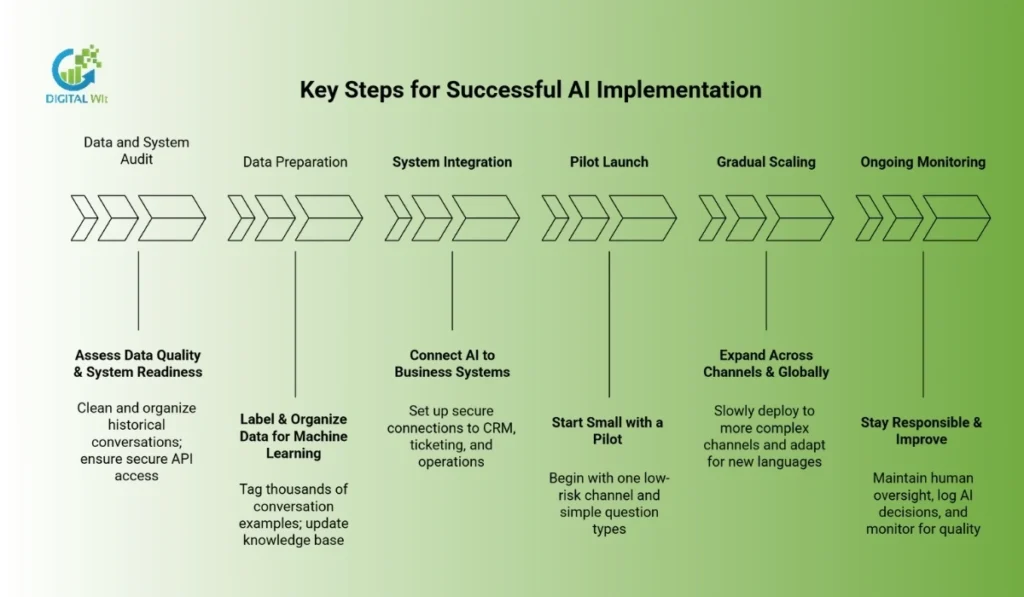
Success requires careful planning and phased execution throughout implementation. This process moves through data preparation, technical integration, and testing.
Check Your Data and Systems
First, audit your data quality and system readiness carefully. Clean and organize historical conversations from past support.
Make sure your systems have APIs that AI can access securely. This foundation is critical for success.
Prepare Data for Machine Learning
Label conversations with customer intents and key information. Tag thousands of examples so AI can learn patterns.
Update your knowledge base to be clear and well-organized. Good preparation means better AI performance.
Connect to Your Business Systems
Set up secure connections to CRM, ticketing, and operations. Map out exactly what AI should do for each request type.
Security protocols must be correctly implemented throughout the entire system architecture.
Start Small With a Pilot
Never launch to everyone at once to minimize risks. Start with one low-risk channel like website chat.
Focus on a few simple question types initially. Monitor performance closely before expanding further.
Scale Gradually Across Channels
After the pilot succeeds, slowly expand to more places. Deploy to more complex channels like email and voice.
Adapt the system for new languages and cultures carefully as you grow globally.
Stay Responsible Throughout Deployment
Always maintain clear paths to human help for customers. Keep detailed logs of AI decisions for compliance reviews.
Have humans monitor AI conversations regularly for quality and continuous improvement opportunities.
What’s Next: The Future of AI Customer Service
AI in customer service will keep advancing rapidly in coming years. The next wave brings systems that anticipate needs and work as teams.
AI Teams Working Together
Instead of one AI, businesses will use specialized teams. One handles understanding customer questions, another does transactions, and a third gathers information.
These AI teams coordinate to solve complex problems automatically and efficiently.
Predicting Needs Before Problems Happen
AI will predict problems before they occur in real-time. It might notice a device failing and send a troubleshooting guide proactively.
Or it could detect that a subscription expires soon and offer renewal options before it lapses.
Voice-First Service Becomes Standard
Voice assistants will become the main customer interface for many companies. Customers will simply talk to their devices to solve problems.
These conversations will sound completely natural and human-like over time.
Self-Improving Systems That Learn
AI will automatically learn from every single interaction it has. It will fix its own mistakes and suggest knowledge updates automatically.
Every successful resolution teaches the system something new for the next interaction.
Industry Transformation Through AI
AI will handle complex tasks in specialized regulated industries. Each industry will develop specialized AI trained on specific knowledge.
Healthcare for scheduling appointments, legal for document assistance, and finance for mortgage questions will all see major changes.
New Human Roles Emerge
Human agents won’t disappear from customer service entirely. They’ll become supervisors, trainers, and complex problem-solvers instead.
Their work will be more interesting and valuable than before, focusing on what humans do best.
Final Thoughts on AI Agents
AI agents are transforming customer service permanently and irreversibly. They deliver efficiency, constant availability, and massive scale consistently. These benefits are now essential in modern business operations.
But success requires balance. AI handles routine work brilliantly while humans provide empathy and solve complex problems. The best approach combines both strengths effectively.
The future isn’t fully automated service. It’s a human-AI partnership where each does what they do best. This creates service that’s both technologically advanced and deeply human.
By deploying AI ethically, maintaining data quality, and ensuring smooth handoffs to humans, businesses can exceed customer expectations. The result is service that’s faster, smarter, and more personal than ever before.
If you’re looking to implement AI-powered customer service solutions or need expert guidance on digital transformation, Digital Wit, the best digital marketing agency in Bangladesh, can help you navigate this exciting journey. Their team combines technical expertise with strategic insight to deliver results that matter for your business.
Frequently Asked Questions
What is an AI agent in customer service?
An AI agent is a software program that uses artificial intelligence to interact with customers automatically. It understands questions, provides answers, and handles support tasks without human help.
How much does it cost to implement AI customer service?
Initial costs range from a few thousand to hundreds of thousands of dollars depending on complexity. This includes software licenses, integration work, and training. Long-term operational costs are much lower than human staff.
Can AI agents replace human customer service teams?
No. AI agents handle routine tasks, but humans are still needed for complex problems and emotional situations. The best approach combines both AI efficiency and human empathy.
How long does it take to set up an AI customer service system?
A basic setup takes 2-4 months. This includes data preparation, system integration, training, and testing. Complex implementations with multiple channels can take 6-12 months.
What types of questions can AI agents answer?
AI agents excel at answering FAQs, checking order status, resetting passwords, providing product information, and basic troubleshooting. They struggle with unique problems requiring human judgment.
Is customer data safe with AI agents?
Yes, if implemented correctly. Businesses must use encryption, follow data protection laws like GDPR, and implement strict security protocols. Always choose reputable AI vendors with strong security measures.
How do customers feel about talking to AI instead of humans?
Most customers prefer AI for simple, quick questions because it’s faster. For complex or emotional issues, they prefer humans. The key is giving customers easy access to both options.
Can AI agents work in multiple languages?
Yes. Modern AI agents support multiple languages and can switch between them during conversations. This makes them ideal for global businesses serving diverse customer bases.