























Vertical AI agents are specialized AI systems built to solve complex problems within one industry. They combine domain knowledge, business rules, data, and connected tools so they can complete useful work—not just generate generic chatbot replies. For a quick foundation, see what AI is and how it works.
Because they understand industry terminology, regulations, workflows, and risk controls, vertical agents can produce more relevant results than general-purpose AI. The right design still depends on clean data, reliable integrations, access controls, and human review for high-impact decisions.
As Bangladesh enters the AI agents era, businesses are exploring specialized automation in healthcare, finance, education, manufacturing, and customer service. Companies that need help connecting an agent to real workflows can review AI agent automation services in Bangladesh.
The most practical way to evaluate a vertical AI agent is to start with one measurable workflow: reduce response time, improve document accuracy, shorten claims processing, or lower the cost of a repeated task. The industry determines the data and controls, while the business outcome determines whether the implementation is worth scaling. For examples, compare AI agents in finance and AI agents in education.
Key Takeaways:
- Vertical AI agents are purpose-built for specific industries with deep domain knowledge
- They deliver higher accuracy than general AI through specialized training data
- These agents automate complex workflows while maintaining compliance standards
- Implementation requires careful planning, quality data, and proper infrastructure
- Industries like healthcare, finance, and manufacturing see measurable productivity gains
Vertical AI Agents vs Other AI Types
Understanding how vertical AI differs from other AI solutions helps businesses choose the right tool for their needs.
Vertical AI Agents vs Horizontal AI
Horizontal AI provides broad tools like CRM assistants that work across any department. Vertical AI goes deeper, solving problems unique to one industry.
It can manage energy grid changes or handle specialized legal work that horizontal tools cannot. The key difference lies in depth versus breadth of knowledge.
Vertical AI Agents vs General-Purpose AI Agents
General-purpose agents rely on broad internet data. Vertical agents use high-quality industry data, ensuring outputs are technically accurate for specific fields.
This means they understand context and nuance that general models miss. A vertical agent knows the difference between medical terminology and everyday language.
Vertical AI Agents vs Rule-Based Automation
Traditional automation follows simple if-then rules. It breaks when facing unexpected situations.
Vertical AI uses smart reasoning to handle new scenarios by applying learned industry knowledge. This flexibility makes them adaptable to changing conditions.
How Vertical AI Agents Work
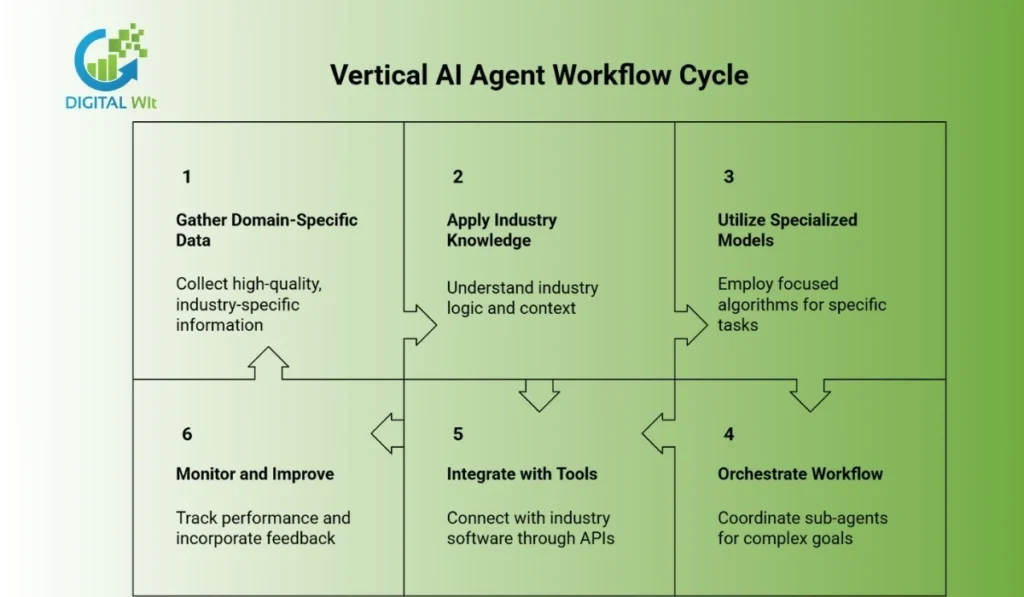
The technology behind vertical AI agents combines specialized data, industry knowledge, and smart algorithms to deliver accurate results.
Domain-Specific Training Data
These agents learn from high-quality, industry-specific information. While general AI learns from public internet content, vertical agents study clinical trials, insurance claims, or legal cases.
This helps them understand the specific language and patterns unique to their field. The quality of training data directly impacts agent performance.
Industry-Specific Knowledge and Context
Beyond raw data, these agents understand industry logic. A banking agent doesn’t just see a large withdrawal.
It understands Anti-Money Laundering regulations and compliance rules. This helps it interpret details that general models would miss.
Specialized Models and Algorithms
Vertical agents often use focused approaches like Mixture of Experts or fine-tuned models optimized for specific tasks. Instead of one giant model doing everything, specialized algorithms handle precise jobs.
These might include predictive maintenance algorithms or credit risk modeling systems. Each component excels at its designated function.
Agent Orchestration and Workflow Execution
Vertical AI doesn’t just chat, it acts. These systems break down complex goals like processing insurance claims into manageable steps.
They coordinate different sub-agents to complete entire business processes automatically. This orchestration enables end-to-end automation.
Integration With Industry Tools
These agents connect directly with specialized software through APIs. They work with Electronic Health Records in hospitals, ERP systems in factories, or financial terminals.
This lets them read and update data in real systems. Seamless integration ensures smooth workflow continuity.
Monitoring and Continuous Improvement
Vertical agents operate in closed-loop systems. Every action gets monitored for accuracy.
When experts correct an agent’s work, that feedback improves the model. This keeps agents updated with changing rules and market conditions.
Core Capabilities of Vertical AI Agents
These powerful features make vertical AI agents valuable across industries.
Autonomous Task Execution
Vertical agents complete multi-step workflows without constant human input. In retail, an agent can identify low stock, contact vendors, negotiate pricing based on history, and update inventory records automatically.
This autonomy frees human workers for strategic tasks. The agent handles routine operations efficiently.
Advanced Decision-Making
These agents use smart reasoning to make professional decisions. In healthcare, a diagnostic agent weighs patient history, lab results, and medical research to suggest the most likely diagnosis.
It provides clear explanations for its recommendations. This transparency builds trust with human experts.
Real-Time Monitoring and Optimization
Vertical agents work as digital supervisors around the clock. In manufacturing, they monitor production sensors and predict machine failures before they happen.
They automatically schedule maintenance to reduce downtime. This proactive approach saves time and money.
Compliance-Aware Operations
In regulated sectors, every action needs legal documentation. Vertical AI agents have built-in safety rules.
They flag trades violating SEC regulations or ensure patient data follows HIPAA and GDPR standards. Compliance becomes automatic rather than manual.
Human-in-the-Loop Controls
Despite their independence, vertical agents support collaboration. They include escalation triggers.
When confidence drops below a threshold or high-value decisions arise, agents pause and present cases to human experts. This balance ensures quality control.
Benefits of Vertical AI Agents
Implementing vertical AI agents delivers measurable improvements across operations.
Higher Accuracy Through Specialization
By focusing on narrow, deep datasets, vertical AI achieves precision general models cannot. In medical diagnostics, vertical agents can reach high accuracy levels in specialized tasks.
This reduces errors in critical environments. Specialization drives better outcomes.
Faster and More Efficient Workflows
Vertical agents compress work that takes days into minutes. In banking, loan underwriting requiring manual review of dozens of documents can complete quickly.
This speed advantage improves customer satisfaction. Efficiency gains multiply across operations.
Improved Customer Experience
Customers expect expert service around the clock. Vertical AI agents act as digital specialists understanding industry jargon and rules.
They provide immediate, accurate answers to complex questions. This builds trust and loyalty.
Reduced Operational Costs
By automating knowledge work, companies scale without increasing staff proportionally. In healthcare, vertical agents can generate significant savings in administrative costs by handling medical coding, billing, and scheduling.
These savings improve bottom lines. Resources shift to value-adding activities.
Scalability Across Specialized Use Cases
Vertical agents handle the long tail of industry problems. They manage sudden claim surges after disasters or optimize supply chains during shortages.
Quality remains consistent even under pressure. Scalability provides business resilience.
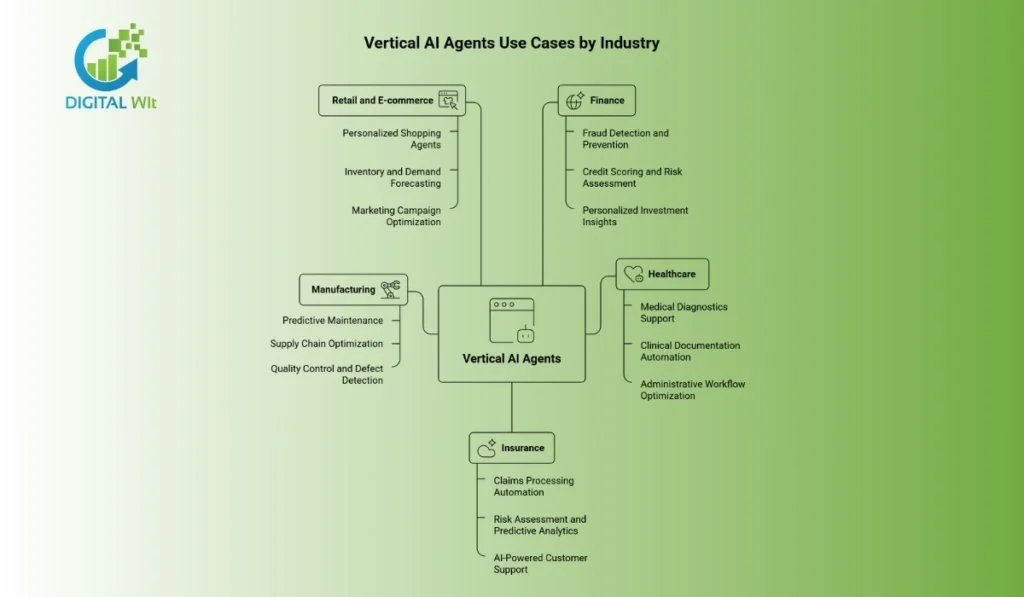
Vertical AI Agents Use Cases by Industry
Real-world applications show how vertical AI transforms different sectors.
Finance
Fraud Detection and Prevention: AI agents monitor transactions in real-time, spotting subtle unusual patterns. They block suspicious transfers and alert analysts, updating regularly to stay ahead of financial crimes.
Credit Scoring and Risk Assessment: Vertical agents analyze spending habits and market conditions for better creditworthiness views. This enables faster approvals and more accurate risk pricing.
Personalized Investment Insights: These agents work as smart advisors with deep market knowledge. They process economic indicators and global news to provide tailored portfolio adjustments matching client goals.
Healthcare
Medical Diagnostics Support: AI agents help doctors by pre-screening images and lab results. In oncology, agents highlight potential issues in scans, improving diagnostic accuracy.
Clinical Documentation Automation: Vertical agents listen to doctor-patient conversations and generate structured clinical notes automatically. This reduces physician burnout from paperwork.
Administrative Workflow Optimization: Agents manage healthcare logistics from patient intake to triage. They predict missed appointments and reach out to reschedule or manage medication inventory.
Insurance
Claims Processing Automation: After accidents, vertical agents analyze damage photos, verify coverage, and estimate costs. They often start payouts quickly after filing.
Risk Assessment and Predictive Analytics: Insurers use agents for dynamic risk assessment. In property insurance, agents combine satellite imagery and climate data to predict damage from weather events.
AI-Powered Customer Support: These policy experts explain coverage details in plain language. They help policyholders understand benefits without human representatives.
Manufacturing
Predictive Maintenance: Vertical agents monitor machinery vibration, temperature, and sound. They detect wear patterns and schedule maintenance before breakdowns occur.
Supply Chain Optimization: Agents analyze global logistics to predict delays. If shipments stall, agents find alternative vendors or adjust production schedules automatically.
Quality Control and Defect Detection: Computer vision agents inspect products with superhuman speed. They spot microscopic defects human eyes miss, ensuring only perfect products ship.
Retail and E-commerce
Personalized Shopping Agents: These agents act as personal stylists or consultants. They understand preferences, trends, and budgets to guide complex purchases in real-time.
Inventory and Demand Forecasting: By analyzing social media trends, weather, and sales history, vertical agents predict trending products. They adjust stock orders to maintain optimal inventory levels.
Marketing Campaign Optimization: Vertical agents segment audiences and manage budgets automatically. They pivot strategies and reallocate spending in real-time to maximize returns.
Implementing Vertical AI Agents
Successful deployment requires careful planning and execution across several key phases.
Identifying High-Impact Use Cases
Start by finding high-volume, repetitive processes requiring specialized knowledge. In law firms, this might be contract review. In hospitals, it could be clinical coding.
Prioritize tasks offering measurable time reductions or accuracy improvements. Focus creates faster results.
Choosing the Right Platform
Look for true agentic capabilities beyond basic chat features. Key criteria include domain pre-training, multi-step planning abilities, and native integrations with core industry systems.
The right platform accelerates deployment. Evaluate vendors carefully based on industry fit.
Data Preparation and Domain Modeling
Vertical AI quality depends on training data. Clean historical data, label industry-specific entities, and create knowledge graphs mapping relationships between data points.
This helps agents understand logic rather than just reading data. Preparation work pays dividends later.
Deployment and System Integration
True integration goes beyond simple APIs. Set up permissions where agents fetch CRM data and update ERP systems.
Establish guardrails preventing actions outside company policy or legal requirements. Secure integration protects business interests.
Performance Optimization and Scaling
After pilots, focus on tuning. Monitor decision patterns and use techniques like Reinforcement Learning from Human Feedback to improve accuracy.
Scale from single departments to enterprise-wide as agents prove reliable. Gradual expansion manages risk effectively.
Data and Infrastructure Requirements
Building robust vertical AI systems requires proper data handling and infrastructure planning.
Structured and Unstructured Industry Data
Vertical agents need both structured data like databases and unstructured data like PDFs and emails. Strong data pipelines must ingest, clean, and normalize these varied formats.
A unified agent memory enables better decision-making. Data architecture matters significantly.
Data Privacy, Security, and Compliance
Infrastructure must support encryption at rest and in transit. Anonymization layers strip personal information automatically.
Audit logs record every agent decision for regulatory reviews. Security protects reputation and compliance.
Cloud vs On-Premise Deployment
Cloud offers rapid scaling and lower upfront costs, ideal for retail and marketing. On-premise or private cloud suits banking and defense where data sovereignty matters.
Air-gapped security prevents data leakage. Choose based on industry requirements and risk tolerance.
Challenges and Limitations
Understanding potential obstacles helps organizations prepare for successful implementations.
Data Quality and Availability
Training data quality directly impacts agent performance. If data is fragmented across legacy systems or contains errors, agents mirror those mistakes.
Many organizations spend significant implementation time cleaning and organizing data. This foundational work cannot be skipped.
Model Bias and Over-Specialization
Agents can become too niche. Training only on specific data subsets makes them struggle when markets shift or new regulations appear.
Constant monitoring prevents tunnel vision. Regular updates keep agents current and relevant.
Maintenance and Model Drift
AI models can degrade over time as real-world data evolves. New fraud tactics or medical standards require periodic retraining on current datasets.
Ongoing maintenance ensures sustained performance. Budget for continuous improvement cycles.
Integration Complexity
Many industries use legacy software built before modern APIs existed. Bridging cutting-edge AI with old mainframes can be technically challenging.
Custom middleware may be required. Plan for integration complexity early in projects.
Measuring ROI of Vertical AI Agents
Quantifying the business impact helps justify and optimize AI investments.
Productivity and Efficiency Gains
AI Scribes in healthcare save physicians time per patient visit, reducing documentation time substantially. Organizations achieve significant productivity increases without adding staff.
Time savings translate to cost savings. Efficiency gains compound across the organization.
Cost Reduction and Revenue Impact
In insurance, automating claims can deliver strong returns through labor savings and faster payouts. Retail AI optimizing inventory increases sell-through rates.
Financial benefits justify investments quickly. Track both cost savings and revenue improvements.
Accuracy, Reliability, and Risk Reduction
Vertical agents in manufacturing using computer vision can deliver returns by reducing defect rates. They provide audit-ready environments, mitigating regulatory fines.
Quality improvements protect brand reputation. Compliance reduces legal exposure and penalties.
Future of Vertical AI Agents
Emerging trends point toward even more powerful and autonomous systems.
Multi-Agent Vertical AI Systems
The next evolution involves agentic orchestration where specialized agents collaborate. In hospitals, separate agents could handle triage, bed management, and pharmacy coordination.
This optimizes entire patient journeys automatically. Coordinated intelligence surpasses individual agent capabilities.
Self-Learning and Adaptive Agents
Future agents will use continuous learning, adapting to industry trends in real-time. Banking agents could learn to identify and block new fraud tactics quickly.
Real-time adaptation increases resilience. Agents become smarter with experience.
Vertical AI Agents in Generative and Agentic Search
We’re shifting from searching for information to requesting results. In legal work, instead of lawyers searching precedents, agentic search systems will find cases, summarize law, and draft preliminary motions.
This transforms how professionals work. Search becomes action-oriented rather than information-gathering.
Final Thoughts
Vertical AI agents represent a significant shift in how industries handle specialized work. They combine deep domain knowledge with autonomous capabilities to deliver accuracy and efficiency that general AI cannot match.
As businesses implement these powerful tools, partnering with experts becomes essential. Digital Wit, the best digital marketing agency in BD, understands how emerging technologies like vertical AI can transform business operations and marketing strategies. Their expertise helps businesses navigate the AI landscape effectively.
The future belongs to organizations that harness vertical AI’s specialized power while maintaining human oversight. Whether in healthcare, finance, manufacturing, or retail, vertical AI agents are becoming essential tools for competitive advantage.
Frequently Asked Questions About Vertical AI Agents
What Makes an AI Agent “Vertical”?
An agent is “vertical” when it is purpose-built for a specific industry like Law or Healthcare rather than general tasks. It understands unique jargon, regulatory rules, and specific workflows that general AI does not.
Which Industries Benefit Most From Vertical AI Agents?
Highly regulated and data-intensive industries see the highest impact. This includes Finance, Healthcare, Insurance, and Legal, where the cost of inaccuracy is high. Manufacturing and Retail follow closely, focusing on supply chain and inventory optimization.
Are Vertical AI Agents Secure and Compliant?
Yes, typically more so than general AI. Vertical agents are often deployed in Private Clouds or On-Premise, featuring compliance-by-design. They include automatic PII stripping and audit logs for every decision.
Can Vertical AI Agents Replace Human Experts?
They act as force multipliers rather than replacements. The goal is to automate routine tasks so experts can focus on meaningful work. An agent handles data entry and initial analysis, but human experts provide final judgment.
How Long Does It Take to Deploy Vertical AI Agents?
A Minimum Viable Pilot can often be deployed in several months. The timeline depends largely on data readiness. If data is clean and systems have modern APIs, integration is fast.
What’s the difference between vertical AI and traditional software?
Traditional software follows fixed rules and requires manual updates. Vertical AI learns from data, adapts to new patterns, and can handle unexpected situations using reasoning rather than rigid programming.
Do I need technical expertise to implement vertical AI?
While technical knowledge helps, most platforms offer user-friendly interfaces. Partner with experienced vendors or agencies who understand both AI technology and your industry requirements.
How much does it cost to implement vertical AI agents?
Costs vary based on complexity, data volume, and integration needs. Start with pilot projects to prove value before scaling. Many solutions offer flexible pricing models based on usage or transactions.
Can vertical AI work with my existing systems?
Most modern vertical AI platforms integrate with existing software through APIs. Legacy systems may require middleware solutions. Evaluate integration capabilities during vendor selection.
How do I measure success of vertical AI implementation?
Track metrics like time saved per task, error rate reduction, cost per transaction, customer satisfaction scores, and overall ROI. Establish baseline measurements before implementation for accurate comparison.ImproveExplain