






















AI agents in education are software systems that can observe student progress, reason about learning goals, and use connected tools to deliver tutoring, feedback, and administrative support. They create more personalized learning experiences while helping teachers spend less time on repetitive work. For the foundation, see what AI is and how it works.
In Bangladesh, AI agents are moving beyond simple digital tools to support real learning workflows. A useful rollout starts with one clear need—such as practice feedback, student questions, lesson planning, or admissions support—then adds privacy safeguards, teacher review, and measurable outcomes.
Key Takeaways
- AI agents provide personalized learning experiences for each student
- Intelligent tutoring systems offer support anytime, anywhere
- Automated grading saves teachers valuable time
- Real-time feedback helps students learn faster
- Accessibility features ensure education for all students
- Data insights help identify struggling students early
- Gamification makes learning more engaging
How AI Agents Work in Education
AI agents can assist with grading drafts, answering common questions, creating practice exercises, translating explanations, and providing one-on-one support. They reduce routine workload, but teachers remain responsible for context, encouragement, and final academic judgment.
These agents can create adaptive study materials and adjust explanations when a learner struggles. Their strongest advantage is not replacing instruction; it is scaling timely, personalized support so students can get help without waiting for the next class.
Core Features of AI Agents
Schools and education businesses should evaluate an agent by accuracy, student privacy, accessibility, teacher adoption, and learning outcomes—not by novelty alone. For organizations planning connected workflows, AI agent automation services in Bangladesh can help turn a pilot into a controlled implementation. Related examples include AI agents in customer service and vertical AI agents for specialized industries.
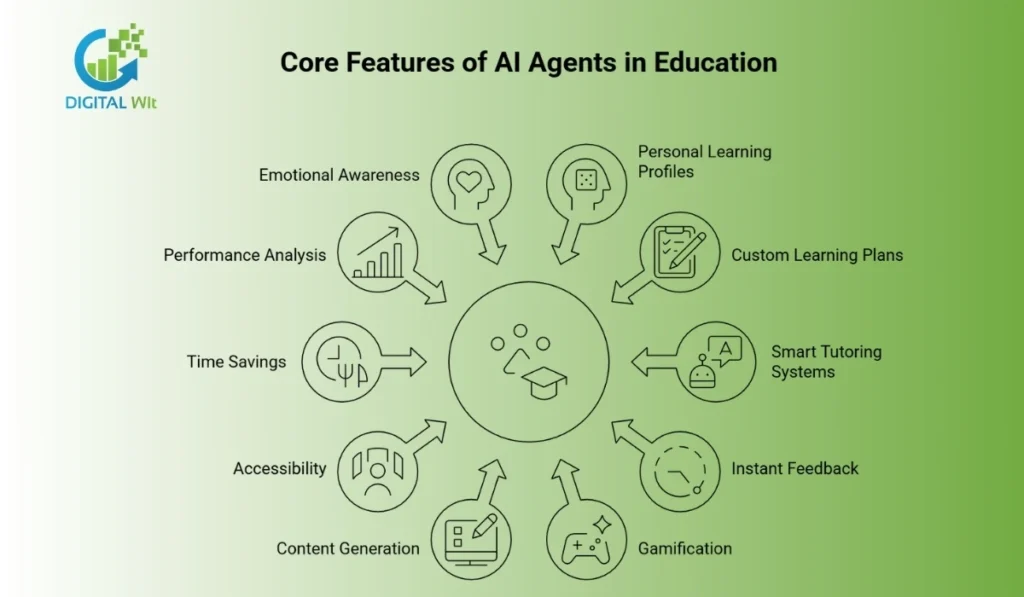
AI agents have special abilities that make them useful for education. These features go far beyond traditional educational software. They enable true interaction and constant adaptation.
Building Personal Learning Profiles
How does an AI know what each student needs? The agent creates a detailed model of the student’s knowledge. This model tracks every answer, every pause, and every success.
It updates continuously with each interaction. This creates a learning profile as unique as a fingerprint. The model guides all teaching decisions.
Custom Learning Plans
Using these profiles, AI creates unique study plans for each student. If someone excels in geometry but struggles with algebra, the agent adjusts accordingly. It suggests specific practice problems and review materials.
This ensures students focus their time wisely. They work only on areas that need improvement. Education becomes student-centered instead of standardized.
Smart Tutoring Systems
Intelligent Tutoring Systems mimic human tutors. They guide students through complex problems step by step. They use natural conversation and ask thoughtful questions.
These systems don’t just give answers. They help students discover solutions themselves. This builds deeper understanding and critical thinking. They’re available constantly, offering unlimited support.
Instant Feedback and Grading
AI agents provide immediate feedback. When students submit work, the agent evaluates it right away. This quick response helps students correct mistakes while concepts are fresh.
For teachers, this means less time grading. Automated grading for essays and assignments is highly accurate. Teachers can focus on mentoring and creative lesson planning instead.
Making Learning Fun
AI agents excel at gamification. They use points, badges, and leaderboards to motivate students. Challenging material becomes enjoyable instead of tedious.
AI-powered games adjust difficulty in real time. This keeps the experience challenging but achievable. It prevents frustration while encouraging continuous effort.
Creating Content Instantly
AI agents generate learning materials at scale. They create quizzes, flashcards, and alternative explanations instantly. This saves curriculum designers countless hours.
The content is smart and adaptable. If a student prefers visual learning, the agent creates diagrams. If they need simpler explanations, it adjusts the text immediately.
Breaking Down Barriers
Accessibility is a vital function of AI agents. They provide instant translation for materials and live subtitles. This helps non-native speakers understand lessons.
AI agents offer text-to-speech and speech-to-text features. This supports students with visual or hearing challenges. Every student gets fair access to education regardless of ability.
Helping Teachers Save Time
AI agents automate administrative tasks. They handle attendance tracking, scheduling meetings, and managing records. This gives teachers huge time savings.
By managing routine duties, AI lets educators focus on what matters most. They can dedicate energy to creative lesson planning and individual mentoring. The agent becomes a digital personal assistant.
Understanding Student Performance
AI agents analyze vast amounts of performance data. They provide insights showing where the entire class struggles. This happens much faster than manual analysis.
Teachers use this information to adjust lessons quickly. Analytics can identify students at risk of falling behind before problems become serious. This proactive approach supports better outcomes.
Recognizing Emotions
Advanced AI agents use emotional awareness. They analyze typing speed, voice tone, or facial expressions. The goal is detecting frustration, confusion, or boredom.
The agent then provides emotional support. It might offer encouragement, suggest a break, or switch topics. This human-centered approach keeps students in an optimal learning state.
Benefits and Challenges
As AI agents become mainstream, we must understand both their benefits and challenges. They offer revolutionary advantages while introducing important considerations about ethics, security, and learning fundamentals.
Major Benefits
Personalized Instruction: The biggest advantage is adaptive learning that matches each student’s pace, style, and knowledge gaps. This individualization is impossible for one teacher to achieve at scale.
Teacher Efficiency: Automating grading, attendance, and record-keeping frees teachers to focus on mentorship and curriculum development. They can dedicate energy to high-level, human-centered instruction.
Always Available Support: Intelligent Tutoring Systems provide quality help outside school hours. Consistent availability ensures learning continues whenever students need assistance.
Early Intervention: AI analyzes performance to identify trends and predict potential problems. Educators receive early warnings about struggling students, allowing timely intervention.
Important Challenges
Fairness Concerns: AI models learn from historical data, which may contain societal biases. Unchecked bias can lead to unfair grading or recommendations. This requires careful monitoring.
Privacy Issues: AI agents collect sensitive student data, including academic records and behavioral patterns. This raises concerns about privacy, security, and potential misuse of personal information.
Understanding AI Decisions: Advanced AI algorithms can be difficult to understand. Students, parents, and teachers may struggle to know why the AI made certain decisions. This affects trust and accountability.
Overdependence Risks: Relying too heavily on AI for answers may reduce critical thinking skills. The technology must enhance, not replace, essential cognitive development.
Access Inequality: Implementing AI systems requires significant investment in technology and training. This may widen the gap between well-funded and under-resourced schools.
Building Responsible AI Systems
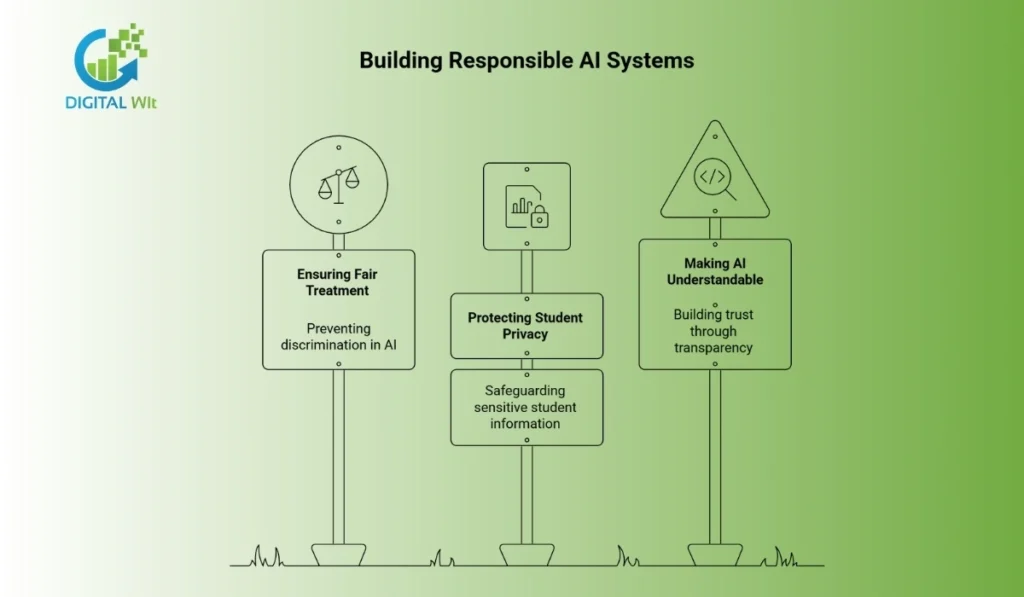
Educational institutions must adopt strong strategies to ensure AI agents are fair, safe, and trustworthy. Success focuses on three areas: fairness, privacy, and transparency.
Ensuring Fair Treatment
The goal is preventing AI from creating or reinforcing discrimination.
Schools must partner with AI developers to ensure training data represents all student backgrounds. Regular audits identify and correct imbalanced data. Any AI recommendation affecting a student’s path must be reviewed by human educators.
Protecting Student Privacy
Protecting sensitive information is essential and requires strict standards.
Schools should collect only necessary data. When possible, personal identifiers should be removed. All contracts with AI providers must address data ownership and secure deletion. Strong encryption and access controls protect student information.
Making AI Understandable
Everyone must understand how AI makes decisions to build trust.
AI systems should provide clear, simple explanations for outputs. For example, explaining why a review topic was suggested. Schools must communicate openly with parents and students about which AI tools are used and what data they collect.
The Future of AI in Education
As challenges are addressed, the next phase promises revolutionary changes. Future agents will be more independent, intelligent, and deeply integrated into learning.
Independent Learning Agents
Tomorrow’s AI will handle complex, multi-step tasks independently. Instead of just creating study plans, future agents could diagnose knowledge gaps, generate personalized lessons, create quizzes, and coordinate with teacher systems automatically. This shifts AI from tool to true collaborator.
Multiple Learning Formats
Current AI mainly works with text and numbers. Next-generation agents will handle text, audio, images, and video together.
Students could upload hand-drawn diagrams for instant grading and feedback. Agents will interpret emotional cues alongside verbal responses to adjust delivery style naturally.
Specialized Learning Models
While large models provide general intelligence, smaller specialized models will drive efficiency. These focused agents can be trained on specific curriculum data, making them highly accurate. This allows robust AI to run directly on tablets and devices.
Combining AI Approaches
Future tutoring systems will blend different AI strengths. Deep learning excels at pattern recognition and language understanding. Rule-based systems are better for complex reasoning tasks. This combination enables agents to not only find answers but explain logical steps clearly.
Global Learning Connections
AI agents will facilitate worldwide collaboration. Automated translation will let students from different countries work together seamlessly. AI will also customize curriculum content to reflect local cultures and contexts. Personalized learning becomes culturally relevant.
Final Thoughts
AI agents are transforming education from a standardized process to a dynamic, student-centered experience. By focusing on responsible implementation and human-AI collaboration, educators can unlock new levels of engagement, accessibility, and achievement.
This educational transformation reflects a larger shift toward AI-driven services. Organizations like Digital Wit, the best digital marketing agency in BD, demonstrate how data and AI drive measurable growth across industries. The future of education is intelligent, personalized, and full of possibility.
Frequently Asked Questions
What is an AI agent in education?
An AI agent is a smart software program that acts like a personal tutor or teaching assistant, adapting lessons to each student’s needs.
How do AI agents personalize learning?
They build detailed profiles of each student’s knowledge and create custom study plans based on strengths and weaknesses.
Can AI agents replace teachers?
No, AI agents support teachers by handling routine tasks so educators can focus on mentoring and creative teaching.
Are AI tutoring systems available all the time?
Yes, Intelligent Tutoring Systems provide support around the clock, helping students whenever they need assistance.
How do AI agents protect student privacy?
Through data encryption, access controls, and strict policies that limit data collection to only what’s necessary.
What subjects can AI agents help with?
AI agents can support virtually any subject, from math and science to languages and humanities.
Do students need special devices to use AI agents?
Most AI agents work on standard devices like tablets, laptops, and smartphones used in schools today.