
























Bangladesh’s e-commerce industry is entering a new era driven by automation, personalization, and intelligent systems. AI agents are software systems that can interpret shopper behavior, plan tasks, and take approved actions across recommendations, inventory, payments, delivery, and support. For a simple foundation, see what AI agents are and how they work. Platforms such as Daraz, Chaldal, and Foodpanda show why local language, trust, delivery coverage, and payment preferences matter as much as the technology.
The local e-commerce ecosystem is embracing intelligent automation, but agents should operate within clear permissions and human review. A practical rollout might begin with product search or order-status support, then expand to returns, inventory, pricing, and marketing after measuring recommendation quality, response time, conversion rate, failed actions, refunds, and customer satisfaction. Businesses that need help planning this workflow can review AI agent automation services in Bangladesh.
Key Takeways
- Bangladesh’s e-commerce is evolving with AI-driven automation and personalization.
- AI agents manage recommendations, pricing, orders, and customer support autonomously.
- Personalization reflects cultural context, regional trends, and individual behavior.
- Integration with platforms, payments, and logistics ensures seamless operations.
- Continuous learning keeps platforms responsive and competitive.
Understanding AI Agents in E-Commerce
AI agents represent the most significant shift in how online businesses operate. Unlike simple automated systems, these agents are designed to act independently, learning from data and making decisions to achieve specific goals. They integrate with digital platforms, observe user behavior, and respond with context-driven actions that enhance both the buying and selling experience.
In Bangladesh’s competitive digital economy, understanding AI agents means understanding the mechanism behind intelligent personalization, efficient order handling, and dynamic pricing, all powered by adaptive algorithms that continuously refine their performance.
The Difference Between Agents and Traditional Software
Traditional e-commerce systems rely on fixed instructions and predictable workflows. AI agents, by contrast, operate with flexibility and autonomy. They interpret goals rather than follow static commands, allowing them to manage situations that change in real time.
This distinction transforms the nature of customer interaction. Instead of being rule-bound, platforms powered by AI agents adapt to context. They can personalize user experiences, predict needs, and self-correct errors, qualities that traditional automation cannot achieve in Bangladesh’s fast-paced online marketplace.
Why AI Agents Matter for Bangladeshi E-Commerce
AI agents are not theoretical upgrades; they are becoming core components of efficient e-commerce ecosystems. In Bangladesh, where consumer expectations and online retail growth continue to rise, AI agents bring a critical advantage. They provide operational intelligence that scales with demand, ensuring that service quality remains consistent even under high traffic or complex customer requirements.
For business owners, this technology means improved cost management and precision in marketing. For customers, it means smoother navigation, relevant recommendations, and responsive communication, hallmarks of a mature digital shopping experience.
Personalization that Understands the Bangladeshi Consumer
Personalization is no longer about greeting users by name. It is about interpreting cultural context, shopping preferences, and behavioral cues unique to Bangladesh’s diverse customer base. AI agents enable this by analyzing browsing habits, regional trends, and seasonal interests.
As a result, e-commerce platforms can deliver experiences that feel genuinely tailored. A customer browsing beauty products on Daraz or home essentials on Chaldal encounters suggestions that reflect individual priorities, not generic promotions. This deeper alignment between data and desire builds brand loyalty in a competitive digital environment.
Efficiency that Strengthens Business Growth
E-commerce growth depends on how well a company can scale its operations without losing accuracy. AI agents strengthen this capacity by managing routine decisions automatically, inventory allocation, order tracking, and query handling. Their ability to work continuously ensures that businesses can focus on innovation instead of maintenance.
In Bangladesh’s expanding online marketplace, where thousands of micro-merchants and startups join every year, this operational precision helps maintain service consistency. The result is faster delivery, fewer errors, and better use of human expertise for creative or strategic tasks.
Inside the System: How AI Agents Work
Understanding the inner structure of AI agents reveals why they outperform conventional automation. These systems combine machine learning, natural language processing, and decision-making frameworks to deliver actions that match both data and intent. For Bangladeshi platforms, the value lies in their ability to adapt across languages, transaction patterns, and customer behaviors that differ widely between urban and regional markets.
AI agents are not single modules but layered architectures where perception, reasoning, and action collaborate. This makes them versatile and scalable across marketing, logistics, and customer service functions.
How Data Becomes Decision
At the heart of every AI agent lies its learning engine. It processes vast datasets from purchase histories, user queries, and browsing behavior, transforming raw information into structured insights. The system learns correlations, what users prefer, when they shop, and how they interact with product categories.
From these insights, it builds predictive models that guide automated decisions. In Bangladesh’s data-rich e-commerce environment, where customer engagement grows daily, this continuous learning loop ensures that every decision reflects current market dynamics rather than outdated assumptions.
Real-Time Adaptation for Seamless Experience
Speed defines customer satisfaction in online shopping. AI agents respond to this demand by operating in real time, analyzing inputs, updating responses, and adapting decisions without delay. This capacity ensures that product listings, recommendations, and support responses remain relevant throughout each interaction.
For platforms like Foodpanda, such responsiveness means faster delivery coordination and smarter order routing. For smaller Bangladeshi e-stores, it translates to a more consistent and trustworthy customer journey.
Bridging Systems with Intelligent Integration
Integration gives AI agents their full potential. These systems connect with e-commerce frameworks, content management systems, payment gateways, and logistics APIs, to form a continuous feedback loop. They do not work in isolation; they communicate across digital channels to synchronize processes.
In Bangladesh, where many businesses operate hybrid systems combining manual oversight and digital tools, intelligent integration helps unify data streams. It allows owners to manage their operations from a single interface while the AI agent handles adjustments automatically.
How AI Agents Transform E-Commerce
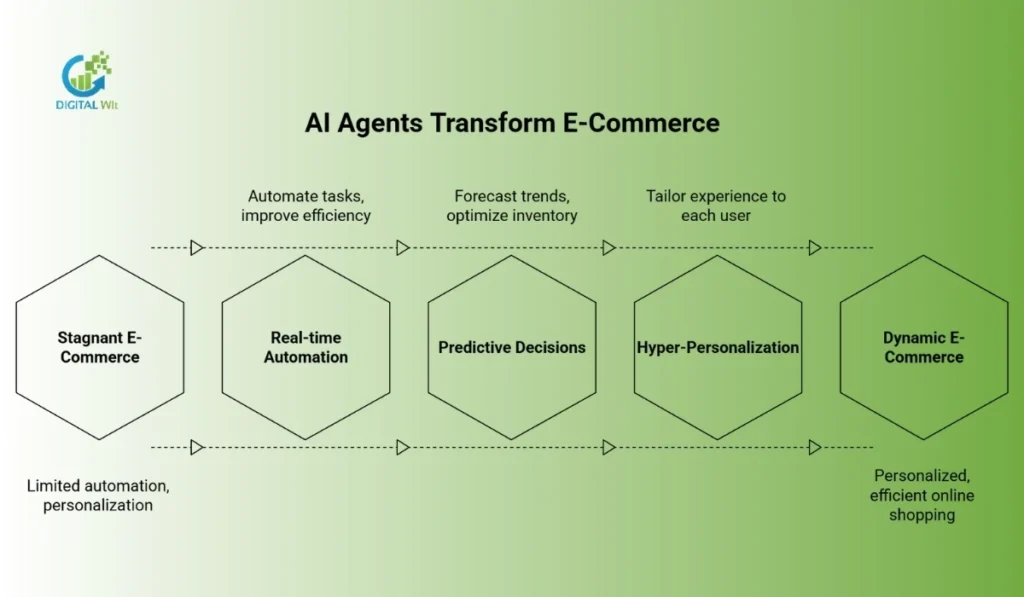
Bangladesh’s e-commerce platforms are rapidly evolving as intelligent AI agents begin reshaping the online shopping experience. These agents provide real-time automation, predictive decision-making, and hyper-personalized engagement for platforms such as Daraz, Pickaboo, and Chaldal.
The shift from static operations to dynamic, agent-driven processes allows businesses to optimize efficiency while responding to local customer preferences. Understanding how AI agents transform operations is critical for Bangladeshi companies aiming to stay competitive in a crowded digital marketplace.
From Static Rules to Dynamic Intelligence
AI agents go beyond traditional, rule-based software by dynamically adapting to changing market conditions. In Bangladesh, platforms like Daraz face diverse consumer behaviors and fluctuating demand, which static systems cannot efficiently manage.
AI-powered decision-making algorithms allow agents to respond instantly to real-time signals, ensuring that pricing, promotions, and inventory management are always aligned with local market trends.
Hyper-Personalization at Scale
Personalized recommendations in Bangladesh now require more than basic product suggestions. AI agents analyze customer behavior, previous purchases, and search patterns across platforms like Pickaboo and Chaldal to deliver highly relevant product recommendations.
Hyper-personalization increases customer satisfaction, encourages repeat purchases, and ensures that local e-commerce platforms remain competitive against both domestic and international marketplaces.
Always-On, Always-Improving Recommendations
AI agents continuously learn from every interaction, improving recommendations with each transaction or click. For Bangladeshi shoppers, this means platforms like Daraz and Pickaboo can offer products that align more closely with individual preferences over time.
Continuous learning ensures that automated systems remain accurate, responsive, and increasingly effective, making AI agents indispensable for agentic commerce.
Automated Customer Support and Chatbots
Conversational AI agents now provide instant, 24/7 support for Bangladeshi customers through integrated platforms such as WhatsApp AI and Messenger AI.
These systems handle inquiries about orders, product details, and returns without human intervention, freeing customer service teams to focus on complex issues. AI-powered chatbots improve satisfaction while streamlining operations, supporting both local SMEs and larger e-commerce platforms.
Real-World Examples
Daraz Bangladesh and Pickaboo are actively implementing AI agents to optimize search results and deliver personalized promotions, illustrating local adoption of agentic commerce.
Even smaller Shopify and Facebook-based stores in Dhaka are integrating AI tools for automated marketing, inventory tracking, and customer engagement. For more industry examples, see AI Agents in Marketing and AI Agents in Autonomous Vehicles.
Components of an AI-Powered Recommendation System
A robust AI recommendation system relies on seamless data collection, machine learning algorithms, and integration with local e-commerce platforms. In Bangladesh, leveraging data from customer behavior, transactions, and preferences allows agents to create predictive models tailored to the local market.
Platforms like Daraz, Chaldal, and Pickaboo can provide actionable, real-time insights through these systems, driving smarter decision-making and more satisfying customer experiences.
Data Collection and Processing
High-quality customer data is the backbone of AI recommendations. Bangladeshi e-commerce platforms track purchase histories, clickstreams, and explicit user preferences to feed AI systems.
Proper preprocessing and structuring of this data ensure that models accurately reflect local consumer behavior, enabling more relevant and timely recommendations.
Machine Learning Algorithms
Machine learning models empower AI agents to detect patterns and forecast future behavior. Techniques including supervised, unsupervised, and reinforcement learning help agents on Daraz and Pickaboo anticipate customer intent and optimize product suggestions. For industry applications, see AI in Healthcare and AI in Finance.
Real-Time Personalization
Real-time personalization ensures that recommendations update instantly based on user interactions. In the Bangladeshi context, a shopper browsing Chaldal for groceries might receive dynamically adjusted offers on complementary products, providing a seamless and highly personalized experience.
Hyper-personalization is central to modern AI e-commerce platforms, driving higher engagement and loyalty.
Integrating with E-Commerce Platforms
AI agents must integrate smoothly with platforms like Shopify, WooCommerce, and Magento, enabling them to ingest data and deliver recommendations back to the storefront.
API connections allow Bangladeshi e-commerce businesses to implement automated product suggestions, dynamic pricing, and AI-driven promotions effectively. This integration ensures that AI capabilities are operational across all consumer touchpoints.
Steps to Build an AI Agent for E-Commerce
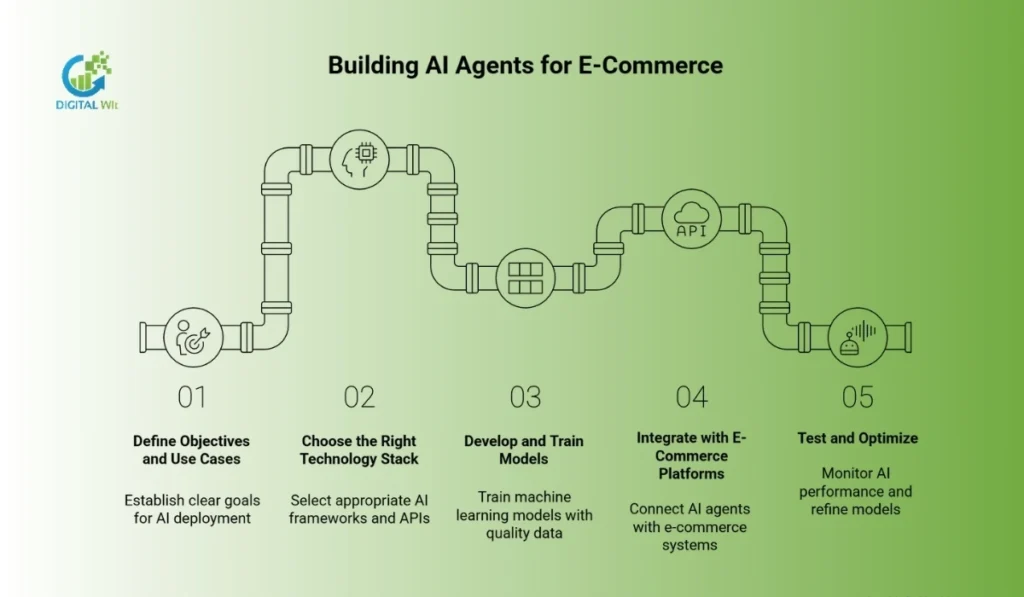
Implementing AI agents in Bangladeshi e-commerce requires careful planning, selection of technology, and iterative testing. From Daraz to local Shopify stores, the adoption of AI frameworks and APIs enables businesses to automate customer interactions and deliver personalized experiences.
Proper integration ensures that agents function seamlessly across product catalogs, payment gateways, and user interfaces.
Define Objectives and Use Cases
Before deploying AI, Bangladeshi e-commerce businesses must identify clear goals. Objectives may include customer personalization, automated support, inventory optimization, or predictive marketing.
Well-defined use cases allow AI agents to deliver measurable improvements in customer engagement and operational efficiency.
Choose the Right Technology Stack
Selecting appropriate AI frameworks and APIs is crucial for system performance. LangChain and OpenAI API are commonly used to develop intelligent, multi-agent systems capable of real-time decision-making.
The technology stack must also support integration with platforms like Shopify, WooCommerce, and Magento for seamless execution.
Develop and Train Models
Training machine learning models requires quality data and preprocessing pipelines. Predictive modeling and reinforcement learning allow agents to understand customer behavior patterns in Bangladesh, enabling accurate recommendations and dynamic adjustments. Data-driven model training ensures continuous improvement and scalability.
Integrate with E-Commerce Platforms
Integration involves connecting AI agents with the e-commerce platform’s backend to access user data, product catalogs, and order information.
APIs and SDKs facilitate communication between the AI models and platforms such as Daraz, Pickaboo, or local Shopify stores. Proper integration guarantees real-time responsiveness and accurate personalization.
Test and Optimize
AI performance should be continuously monitored using metrics such as recommendation accuracy, conversion rates, and customer engagement. Iterative testing allows Bangladeshi businesses to refine models, enhance system reliability, and adapt to evolving user behavior. Optimization ensures that AI agents remain effective across all operational scenarios.
Best Practices for Implementing AI Recommendations
AI adoption in Bangladesh’s e-commerce requires a strategic, measured approach to ensure effectiveness and customer trust. Following best practices reduces risk and maximizes the impact of AI-powered systems for both large platforms and SMEs.
Start with a Pilot Program
Launching AI recommendations on a small scale allows businesses to validate effectiveness. Platforms can A/B test new systems, gather feedback, and adjust strategies before full deployment. Pilot programs minimize disruption while demonstrating AI value to stakeholders.
Ensure Data Privacy and Compliance
Bangladesh’s data regulations require strict adherence to privacy and security standards. AI agents must comply with GDPR where applicable and local enterprise-grade security measures. Protecting customer data builds trust and ensures sustainable adoption of intelligent systems.
Monitor Performance Metrics
Tracking KPIs such as engagement rates, conversion rates, and predictive accuracy is essential. Regular monitoring ensures AI agents deliver consistent value and provides actionable insights for improvements. Predictive metrics enable proactive decision-making and system tuning.
Enterprise-Grade Security and Compliance
AI systems must employ robust encryption, access controls, and secure infrastructure. Compliance with local regulations and industry standards safeguards sensitive customer information while maintaining operational integrity.
Use Cases and Examples of AI Agents in E-Commerce
Bangladeshi e-commerce platforms are rapidly adopting AI agents across multiple domains, from customer support to inventory management. Agentic systems provide actionable insights and automate processes for enhanced operational efficiency.
Personalized Shopping Assistants
AI agents analyze purchase history, browsing patterns, and user preferences to deliver targeted product suggestions. Platforms like Daraz and Pickaboo leverage these agents to enhance customer satisfaction and boost repeat purchases. See AI Agents in Marketing for related use cases.
Conversational Customer Support
Chatbots and virtual assistants provide 24/7 support through WhatsApp AI, Messenger AI, and in-app solutions. Local platforms use conversational agents to handle inquiries, track orders, and solve issues instantly, reducing workload for human agents.
Automated Inventory Management
AI agents predict stock demand and automate restocking for local e-commerce operations. Predictive analytics ensures that items remain available while reducing overstocking, particularly important for fast-moving products in Bangladesh.
Dynamic Pricing and Deal Hunting
Intelligent agents analyze market trends and competitor pricing to adjust prices in real-time. Platforms like Daraz optimize promotions and discounts using predictive pricing models to maintain competitiveness.
Fraud Prevention and Risk Management
AI agents detect anomalies and suspicious behavior patterns to prevent fraud. Bangladeshi e-commerce platforms implement these systems to safeguard transactions and reduce financial losses.
Omnichannel Engagement and App Loyalty
AI agents enable cross-platform integration, allowing customers to engage via mobile apps, websites, and social media. Local stores use these systems to encourage loyalty programs, push notifications, and in-app recommendations.
Voice-Enabled Shopping Assistance
Voice AI and speech recognition tools allow Bangladeshi consumers to shop using natural language commands. Conversational AI agents improve accessibility, providing a frictionless shopping experience.
Benefits of AI Agents for E-Commerce
For Businesses
AI agents help optimize inventory, automate marketing, and provide actionable analytics dashboards. For platforms like Daraz and Pickaboo, this translates into increased efficiency, lower operational costs, and better decision-making.
For Customers
Shoppers experience personalized recommendations, real-time support, and seamless interactions. Hyper-personalization driven by AI agents ensures satisfaction and loyalty in Bangladesh’s competitive e-commerce market.
Challenges and Concerns for Bangladeshi E-Commerce
Data Security and Trust
Cybersecurity concerns and compliance with local laws remain critical for AI adoption. Protecting sensitive customer data is essential to build trust and encourage widespread use.
Technology Literacy Gap
Limited digital literacy and training requirements slow adoption. Educating staff and customers ensures effective use of AI systems.
Initial Implementation Costs
Deploying AI platforms and infrastructure can be costly for SMEs. Strategic investments and phased implementation reduce financial risk.
Cultural Acceptance and Bangla NLP Limitations
Natural Language Processing in Bangla is still developing. AI agents must adapt to linguistic nuances and local communication preferences to succeed.
Internet Infrastructure and Access
Reliable mobile internet and network coverage are necessary for AI-driven experiences. Challenges in rural areas may limit reach and effectiveness.
Success Examples of AI in E-commerce
Global Examples – Amazon, Alibaba
These platforms showcase agentic commerce at scale, integrating AI agents for personalized recommendations, inventory management, and customer engagement.
Local Examples – Daraz Bangladesh, Pickaboo
Daraz and Pickaboo implement AI agents for search optimization, dynamic promotions, and chat-based support. Even small Facebook/Shopify stores are integrating AI tools to improve local e-commerce operations.
Future of AI Agents in Bangladeshi E-Commerce
Predictions for Next 2–5 Years
AI adoption in Bangladesh will accelerate, with platforms increasingly implementing agentic commerce and multi-agent systems. Emerging e-commerce startups will leverage AI to compete effectively against established players.
Opportunities for Startups and Small Businesses
Local SMEs can benefit from affordable AI tools to enhance personalization, automate support, and optimize operations. AI adoption lowers entry barriers and fosters entrepreneurship.
Government and Private Initiatives Supporting AI Adoption
Bangladeshi government programs and private accelerators support AI integration in local e-commerce. Initiatives focus on skill development, infrastructure, and platform enablement.
Encouraging Local Entrepreneurship with AI
AI agents empower local entrepreneurs to launch data-driven businesses with scalable operations. See AI Agents in Vertical Industries for opportunities across banking, insurance, and more.
Conclusion
AI agents in Bangladeshi e-commerce deliver hyper-personalization, automated support, and data-driven business insights. They improve customer experience while optimizing operations across platforms like Daraz and Pickaboo.
Early adoption allows businesses to remain competitive, reduce operational costs, and enhance customer loyalty. With strategic guidance from Digital Wit, which is the best digital marketing agency in Bangladesh, brands can integrate AI solutions effectively and scale faster.
AI-powered platforms represent the future of e-commerce in Bangladesh. Exploring AI Agents use cases can inspire businesses to implement agentic solutions across industries and seize emerging opportunities.
FAQs About E-Commerce AI Agents
Can AI Agents Make Purchases Without Human Input?
Yes. AI agents can execute automated purchases, track inventory, and reorder products according to predefined rules and predictive models.
How Safe is Agentic Commerce for Customer Data?
Properly implemented AI systems comply with Bangladeshi regulations and data security standards. Enterprise-grade encryption ensures customer information is protected.
How Do Businesses Start Implementing AI Agents?
Businesses should define objectives, select the right technology stack, develop models, integrate platforms, and continuously optimize performance. See AI adoption guide for a step-by-step roadmap.
How can businesses balance human oversight with autonomous AI decision-making?
Use AI for routine, high-volume tasks while keeping humans in control of strategic decisions, exception handling, and final approvals through clear rules and monitoring.
What metrics should Bangladeshi e-commerce brands track to measure AI agent success?
Track conversion rate, recommendation click-through, customer satisfaction, order accuracy, response time, and cost savings.