























AI agents are changing the world. They automate decisions, process data, and do tasks without constant human help. These smart systems use machine learning and natural language processing. They also use computer vision to act like humans. People use AI agents in business, healthcare, education, and everyday life. They help customers, analyze data, and handle repetitive work.
AI agents automate workflows across many industries. This boosts productivity everywhere. Organizations using smart automation get faster results. They make fewer errors and spend less money. Microsoft Azure AI and Google Cloud AI power these systems around the world.
Modern organizations use these systems for many tasks. In business, they handle customer support and sales. In healthcare, they help diagnose patients. In education, they personalize learning. They manage data analysis and human resources too. This change happens through three main features: smart decisions, learning ability, and self-running tasks.
Unlock Smart Automation for Business Growth
AI agents are software tools. They act like humans. They make automated decisions and interactions. They use AI technologies like machine learning and natural language processing. They also use computer vision. These tools complete tasks and improve workflows. They reduce the work human employees must do.
In business, AI agents boost efficiency. They work faster and at larger scale than humans. They make fewer errors too. AI agents handle customer questions and automate repetitive tasks. They analyze complex data. These agents help make operations smoother. They also help in key areas: finding core abilities, checking key factors, and telling smart systems from rule-based ones.
Discover Core Abilities and Business Impact
AI agents act like humans through advanced algorithms. They make automated decisions across business operations. IBM Watson and Salesforce Einstein lead the way. These enterprise AI platforms power smart automation worldwide.
Check Key Factors Before Starting
Before using AI agents, businesses should check several things. Look at integration, data quality, customer experience, and security rules. Learning how AI agents work step-by-step helps companies prepare. Good data helps AI models give accurate results. This also helps meet rules like GDPR and CCPA.
Tell Smart Systems from Rule-Based Systems
Traditional automation tools follow pre-set rules. AI agents use machine learning for dynamic decisions. They use natural language processing too. Different designs serve specific business needs across industries.
Explore Advanced Solutions and Platform Options
AI agents vary in complexity and abilities. They vary in focus across different business tasks. From language models to data processing systems, these tools solve specific problems. Knowing the available AI agent solutions helps businesses pick the right technology.
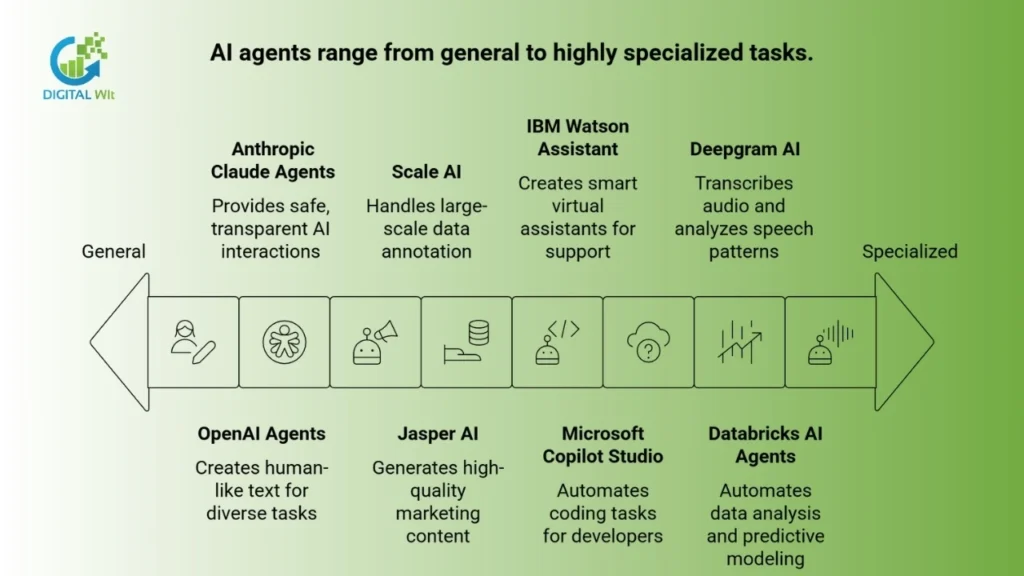
OpenAI, Anthropic, and Microsoft lead AI agent development. These systems power many applications. They automate customer support and handle complex data analysis. This ecosystem includes OpenAI agents and Anthropic Claude agents. It includes Jasper AI, Scale AI, and Microsoft Copilot Studio. It also includes IBM Watson Assistant, Databricks AI agents, and Deepgram AI. Arthur AI and Gong AI are part of this too.
Unlock GPT Model Abilities for Content
OpenAI’s GPT-3 and GPT-4 models are powerful AI agents. They create text that sounds human. These models help with many tasks. They create content and provide technical support. OpenAI agents work in chatbots and virtual assistants. They work in creative apps like writing and translation tools.
Focus on Claude Framework for Ethical Work
Claude is a family of AI models from Anthropic. They focus on safety and transparency. Claude agents provide ethical and controlled AI interactions. These AI agents help in sensitive industries. They work in healthcare, legal services, and finance.
Speed Up Jasper Platform for Marketing Growth
Jasper AI focuses on content creation and marketing. Jasper creates high-quality written content. This includes blogs, articles, and social media posts. It adapts to different writing styles. This makes it useful for marketing teams.
Scale Smart Systems for Data Processing
Scale AI offers advanced machine learning models. They handle data tasks like annotation and classification. This AI agent works in many industries. It helps with self-driving cars, online shopping, and healthcare. Scale AI speeds up AI training. It cuts the time needed to develop accurate models.
Simplify Copilot Development for Coding Speed
Microsoft Copilot Studio is an AI-powered tool for developers. It helps businesses add AI agents to their workflow. Copilot Studio automates tasks like creating code. It detects errors and helps with debugging.
Improve Watson Assistant for Support Work
IBM Watson Assistant is an AI-powered chatbot platform. It creates smart virtual assistants. Watson Assistant works with existing customer service systems. It uses natural language processing and machine learning. This helps it understand customer questions.
Optimize Databricks Platform for Analytics
Databricks is a unified analytics platform. It uses AI to process large amounts of data. Databricks AI agents automate data analysis. They help with predictive modeling. They optimize machine learning workflows. Businesses can smooth out data operations. They can find valuable insights from datasets.
Deepgram for Voice Recognition
Deepgram provides AI agents for speech recognition. They understand natural language. These agents transcribe audio and analyze speech patterns. They provide insights into customer interactions. Deepgram’s AI technology helps call centers. It helps healthcare and legal services too.
Arthur for Model Oversight
Arthur AI focuses on ethical AI use. It makes sure models are clear and explainable. They align with business goals. Arthur AI agents monitor machine learning models. They identify biases and errors.
Gong for Sales Intelligence
Gong AI is a sales intelligence platform. It uses AI to analyze sales calls. By reviewing customer conversations, Gong AI gives insights. It shows sales performance and customer objections. Sales teams can improve their pitches. They can boost overall results.
Expand Industry Solutions Across Business Tasks
AI agents work across industries. They improve workflow automation and service delivery. Many real-world examples show how companies use smart automation. Customer Support AI agents respond to queries right away.
Use Specialized Solutions for Sector Needs
AI agents meet specific needs in different industries. These specialized systems solve unique challenges. They work in healthcare, finance, manufacturing, and retail. Domain knowledge combined with smart automation helps companies solve complex problems.
Healthcare
In healthcare, AI agents help with diagnostic tools. They monitor patients and handle administrative tasks. They analyze patient data and recommend treatments. They help manage appointments. AI agents reduce human error. They make healthcare workflows smoother.
Finance
AI agents in finance help with risk analysis. They detect fraud and forecast finances. They spot irregularities in transactions. They manage financial records and automate customer service. These systems improve security. They ensure compliance with regulations.
Manufacturing
AI agents in manufacturing improve production. They optimize supply chain management. They monitor machinery health. They analyze machine data to predict maintenance needs. This minimizes unexpected equipment failures.
Retail
In retail, AI agents manage customer interactions. They personalize shopping experiences. They optimize inventory management. They provide tailored product recommendations. They assist customers in real-time. AI-powered engines analyze purchase history and browsing patterns.
Maximize Customer Support Speed and Performance
AI agents in customer support provide faster responses. They give consistent service quality. They handle more inquiries. These systems keep customer support always available. Automating routine customer service tasks with AI agents cuts labor costs.
AI agents analyze customer data. They offer personalized solutions. They handle thousands of inquiries at once. This lets businesses scale operations. Customer support includes understanding AI agents. It includes comparing them with chatbots. It includes finding request types and checking security.
Support Automation Benefits
AI agents in customer support provide faster responses. They give consistent service quality. These systems keep customer support always available. Automating routine tasks with AI agents cuts labor costs. It frees up human agents.
Automated Support Basics
AI agents for customer support are automated systems. They handle customer questions and solve issues. These agents use natural language processing and machine learning. They understand queries in real time. They take various forms. These include chatbots, virtual assistants, and self-service portals.
Support Tech Intelligence Levels
Both AI agents and regular chatbots help customers. But they differ in complexity. Regular chatbots follow preset scripts for simple queries. Comparing systems helps businesses pick the right technology.
Identify Request Types and Support Range
Customer support AI agents handle many tasks. They handle simple queries and complex interactions. Common requests include Order Status and Product Questions. They include Technical Support and Account Management. Automating these tasks reduces work for human agents.
Keep Data Safe with Security Rules
Security is critical when using AI agents for customer support. Good systems use security measures. These include Encryption and Authentication. Compliance ensures AI systems follow data protection laws. These include GDPR and CCPA.
Handle Edge Cases with Backup Systems
AI agents may sometimes misunderstand customer requests. Advanced AI agents handle this by escalating to human agents. AI agents ask follow-up questions. This helps them better understand queries.
AI Agent Features & Benefits
AI agents transform how businesses approach customer service. They change sales and operations. Key features include automation, scalability, and intelligence. Automation simplifies repetitive tasks. Scalability lets AI agents handle thousands of interactions at once.
Intelligence powered by machine learning lets AI agents respond in real-time. Use cases include customer support and sales automation. They include personalized marketing. This section covers feature comparison and ROI analysis. It covers benefits, availability, responses, and quality. It covers scaling, business transformation, and key takeaways.
Feature & Price Comparison
AI agents transform business through automation and scalability. They use smart processing. Automation simplifies repetitive tasks. These include answering FAQs and processing orders. Scalability lets AI agents handle thousands of interactions at once.
Measure Returns Through Investment Metrics
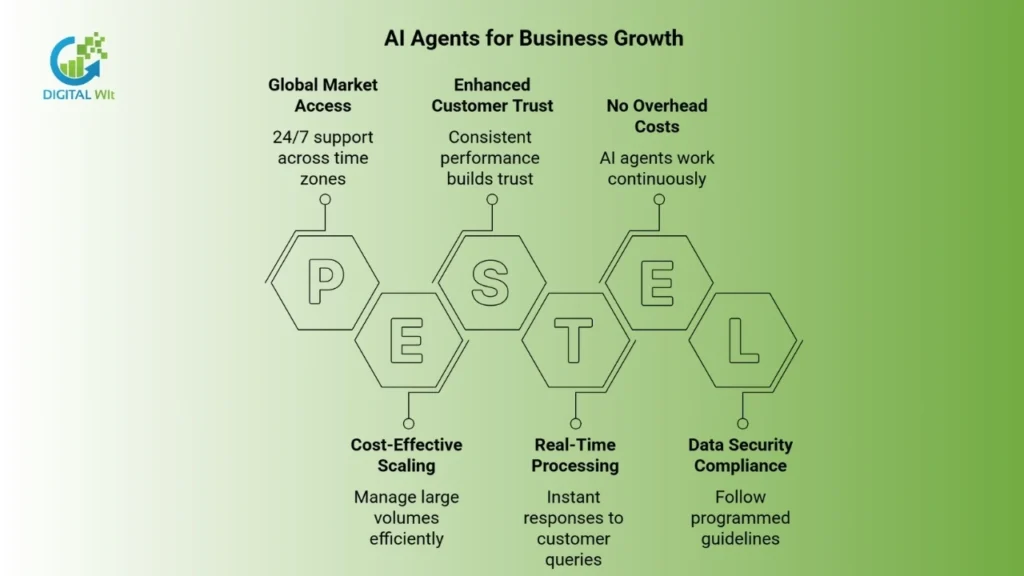
AI agents deliver impressive returns. They boost efficiency and cut costs. Automating customer service reduces the need for large support teams. AI agents work continuously. They have no overhead costs like human labor does.
Transform Operations with Core System Advantages
AI agents offer benefits for improving customer interactions. They help internal workflows. Checking cost-benefit analysis between free and paid platforms helps companies allocate budgets wisely. Continuous availability keeps customer support always accessible.
24/7 Support Availability
AI agents provide customer service all day and night. This availability helps businesses serve global markets. It helps with different time zones. AI agents interact with customers in multiple languages.
Instant Query Processing
AI agents deliver instant responses to customer queries. They analyze customer input in real-time. This ensures quick solutions. They are effective at handling simple, repetitive tasks quickly.
Performance Quality Standards
AI agents offer consistent performance. This consistency builds trust with customers. AI agents follow programmed guidelines. They are not prone to human errors.
Scalable AI Operations
AI agents scale to meet changing customer interaction volumes. Whether 10 or 10,000 inquiries, AI agents manage large volumes at once. Scaling AI agents is cost-effective.
Smart Workflow Automation
AI agents change business operations. They automate routine tasks. They simplify workflows and boost productivity. AI agents use data-driven insights. This helps in decision-making.
Implementation Speed Optimization
AI agents transform workflows. They automate mundane tasks and improve accuracy. Task Automation reduces manual work. It boosts productivity. Real-Time Processing helps businesses respond quickly to changing conditions.
AI Solution Selection
When selecting AI agents, consider how well they fit into workflows. Customization and Flexibility mean choosing AI agents tailored to business needs. Scalability ensures AI agents scale as your business grows.
Navigate Implementation Problems and Solutions
AI agent implementation can present several challenges. Understanding these challenges makes the process smoother. Integration Complexity involves adding AI agents to existing systems. Data Security Concerns arise as AI agents handle sensitive data.
User Adoption means employees may resist AI agents. This section addresses implementation challenges. It covers integration complexity and data security concerns. It covers user adoption and security and compliance considerations.
Implementation Problem-Solving
AI agent implementation can present challenges. These require careful planning. Integration Complexity involves aligning AI technology with legacy software. Data Security Concerns arise as AI agents handle sensitive customer data.
System Integration Design
The complexity of integrating AI agents is often underestimated. The challenge lies in aligning AI technology with legacy software. Proper integration ensures AI tools work well with current systems.
Advanced Security Measures
AI agents handle large amounts of sensitive data. Any vulnerability can lead to data breaches. Regularly updating security measures helps. Using data encryption reduces risks.
Employee AI Training
Employees may hesitate to adopt AI agents. Overcoming this resistance is key to success. Involving employees early helps. Providing training demonstrates improvements.
Compliance Standards
Businesses must ensure compliance with relevant laws. AI implementation must follow privacy laws. These include GDPR and CCPA. Data Protection requires ensuring AI agents comply with international laws.
Track Performance with Measurement Systems
Tracking key performance metrics shows the value of AI agents. These metrics provide insights into how well AI agents perform. Operational Metrics assess efficiency in doing tasks. Business Metrics assess contribution to goals like cost savings.
Technical Metrics evaluate performance and reliability. By tracking these metrics, businesses gain insights. They learn about efficiency and impact.
Success Measurement Framework
Tracking key performance metrics shows the value of AI agents. These metrics provide insights into performance and business goals. Operational Metrics assess efficiency in doing tasks. They check automating workflows.
Build Solutions with Strategic Development Framework
Building AI agents requires strategic planning. It requires clear objectives. Companies must start with a clear problem statement. Mapping inputs, decisions, actions, and success criteria ensures alignment.
LangChain, AutoGPT, and CrewAI represent popular AI agent frameworks. Data readiness checklists ensure AI agents have the foundation needed. This section covers best practices and AI agent frameworks. It covers building smarter systems, getting started, and development tools.
Proven Implementation Strategies
Start with a clear problem statement. Pick a high-impact use case. Map inputs, decisions, actions, and success criteria before building. Pilot with a limited audience. Measure results, then scale.
Technical Framework Selection
Choose a framework that matches your stack and skills. For orchestration and multi-step tasks, consider graph-based runtimes. Focus on features. These include state management, memory, and safety guards.
Modern Development Tools
Define the agent’s role, abilities, and tools first. Connect only the APIs it needs. Design robust tool schemas. Add validations and clear error messages.
Deployment Implementation Process
Check workflows with clear ROI and measurable success. Design the task graph and decision points. Design tools and guardrails. Build the agent and connect tools. Add tests.
Tools for System Performance
Workflow orchestration requires choosing graph-based runtimes. Retrieval and memory systems use vector stores. They use metadata filters. Evaluation involves adding unit tests and human review.
AI Agent FAQs
How Much Do AI Agents Cost to Implement?
The cost varies depending on task complexity. It depends on tools used. Simple chatbot systems might cost a few hundred dollars per month. Factors include Development Costs, Integration Costs, and Ongoing Maintenance.
Can I Build My Own AI Agent Without Programming Experience?
Yes, you can build an AI agent without programming experience. Use no-code platforms. These tools let users design and deploy AI agents through graphical interfaces. Popular platforms include Chatbot Builders and Automated Workflow Tools. They include AI Platforms with Pre-Built Models.
What Business Processes Work Best for AI Agent Automation?
AI agents excel at automating repetitive tasks. They work well with processes involving large amounts of data. Customer Support allows AI agents to handle common questions. Sales and Lead Generation automation qualifies leads. It schedules meetings.
Which AI Agent Platform Is Best for My Business?
The best platform depends on your needs. It depends on task complexity and budget. Understanding career paths and pay in the AI industry helps professionals evaluate opportunities. OpenAI is best for businesses needing advanced natural language processing.
Are AI Agents Suitable for Small Businesses?
Yes, AI agents are highly beneficial for small businesses. Affordable platforms allow small businesses to implement automation. AI agents help Save Time and Money. They Improve Customer Experience. They Scale Operations.
Conclusion
AI agents change business operations. They automate routine tasks and improve customer interactions. With applications ranging from customer support to sales, AI agents suit businesses of all sizes. By adopting the right AI platform, companies reduce costs. They stay competitive.
To take advantage of AI agents, start by checking your business’s needs. Identify processes that could benefit from automation. Research and choose the best AI agent platform for your goals. Keep in mind the level of complexity required. Think about the scalability of the solution. Ensure proper integration with your existing systems. Train your team to use AI effectively. Over time, optimize and refine the AI system. This improves its accuracy and performance.
Don’t hesitate to contact Digital Wit for guidance. We can help you integrate AI agents into your operations. Our team is here to help you navigate the complexities of AI adoption. We offer the right tools and support to boost your business’s productivity. We improve customer engagement. Reach out to Digital Wit today for a consultation!