























ChatGPT has transformed how businesses communicate with customers and create content. Millions use it daily for everything from writing emails to answering complex questions. But here’s the confusion: Is ChatGPT actually an AI agent, or is it something else entirely?
The answer matters more than you might think. Understanding what ChatGPT can and cannot do helps businesses make smarter decisions about AI tools. Many assume that because ChatGPT seems intelligent, it must be a full AI agent. The reality is different. ChatGPT excels at generating human-like text, but it lacks the autonomy and decision-making power that define true AI agents. This distinction shapes how businesses should use these tools and what results they can expect.
Key Takeaways
- ChatGPT is a language model that generates text responses, not a true AI agent with autonomous capabilities.
- AI agents make decisions and execute tasks independently, while ChatGPT waits for user prompts to respond.
- ChatGPT excels at conversational tasks and content creation but cannot handle multi-step workflows autonomously.
- AI agents integrate with business systems to automate processes, while ChatGPT provides text-based interactions only.
- ChatGPT doesn’t retain memory between sessions, whereas AI agents learn from past interactions.
- Businesses need AI agents for complex automation and ChatGPT for conversational engagement.
- AI agents represent the future of business automation with their ability to work independently.
ChatGPT: A Language Model, Not an AI Agent
ChatGPT is an advanced language tool. It creates human-like responses based on what you type. People often call it an AI tool. But it’s not technically an AI agent. Why? It can’t perform tasks on its own or handle complex decisions.
Unlike AI agents that handle multiple steps autonomously, ChatGPT’s function is limited. It generates responses based on natural language processing. AI agents work differently. They can manage entire workflows without constant supervision.
ChatGPT handles conversations well. But it can’t execute actions or make decisions independently. Full AI agents used in business operations work much differently.
What Defines an Agent Beyond Chat
AI agents are both reactive and proactive. They make decisions without constant human help. These agents do tasks on their own. They handle decision-making, data processing, and multi-step workflows. ChatGPT relies on your prompts. It can’t make decisions or perform complex tasks alone.
AI agents integrate into broader systems. They adapt in real-time to changing conditions. ChatGPT’s functionality is limited. It generates responses based on set language patterns.
ChatGPT is powerful for creating human-like text. But it doesn’t have the autonomy needed to be a full AI agent.
Task Ownership , Passive vs Active AI
ChatGPT operates passively. It waits for instructions and responds to your input. AI agents take active roles. They start and manage tasks on their own. For example, an autonomous agent could analyze customer data automatically. It responds to inquiries without manual help. ChatGPT can only generate a response after you give it a prompt.
This fundamental difference matters for business applications. AI agents suit complex tasks that need active decision-making. ChatGPT works better for reactive tasks. These include answering questions or providing information based on your input.
How ChatGPT Handles Language
ChatGPT excels at natural language processing. It understands and generates human-like text. But its capabilities stop at processing text-based input. It can’t handle real-time decision-making or data integration. AI agents can manage these tasks.
AI agents take action based on data or external triggers. ChatGPT’s function is confined to interaction-based scenarios. The outcome is a generated response, not an actionable decision. This makes ChatGPT effective for chatbots and conversational AI use cases.
When a Language Model Is Not Enough
ChatGPT is a robust conversational agent. But it lacks abilities needed for many real-world tasks beyond simple communication. AI agents used for task automation work differently. They handle process management and complex decision-making. They act autonomously based on data. They adjust to changes in real-time without your input.
Real-time decision-making is needed in customer service or inventory management. ChatGPT wouldn’t work well in these situations. It lacks the necessary functionality to make autonomous decisions. It can’t integrate with external systems.
Data Access and Memory Management
ChatGPT doesn’t retain memory between interactions. Each session is independent. This secures user data privacy. This feature is ideal when data retention isn’t necessary. AI agents often retain data across sessions. They learn from past interactions. This helps them make better decisions over time.
Memory retention allows AI agents to offer more personalized services. They work more efficiently. But this raises privacy concerns. These need careful management, especially in regulated industries.
ChatGPT vs AI Agents: Key Differences
AI agents carry out tasks autonomously. They make decisions and interact with users or environments based on real-time data. These agents perform complex workflows. They integrate into broader systems. ChatGPT is limited to generating text responses. It lacks the ability to perform autonomous actions or manage ongoing workflows.
AI agents possess decision-making capabilities. ChatGPT is primarily reactive. It only responds to prompts. This distinction shapes how each is used in business contexts. AI agents automate processes. ChatGPT only generates conversational outputs.
The key difference is autonomy. AI agents drive complex workflows. ChatGPT’s capabilities are confined to text-based conversations. This makes it ideal for specific tasks but not for broader automation.
Key Differences Between ChatGPT and Traditional AI Assistants
Traditional AI assistants like Siri and Alexa handle simple tasks. They set reminders or answer basic queries. These assistants require human prompts. They work within limited domains, responding to direct commands. AI agents used in enterprise settings work differently. They include customer service and workflow management. They take on complex tasks autonomously.
AI agents integrate with business systems. They automate processes. They make real-time decisions based on incoming data. ChatGPT is confined to providing textual output. This makes it useful for content generation or simple chat applications. But it can’t manage multifaceted tasks autonomously.

Deep Dive on What ChatGPT Can Do That Others Can’t
ChatGPT excels at generating written content. It provides quick answers. It simulates human-like interactions. People use it widely in customer service bots, content creation tools, and educational platforms. However, multi-step processes aren’t its strength. It’s not suited for real-time decision-making. AI agents typically handle these tasks.
AI agents automate entire workflows. ChatGPT operates in a passive manner. It waits for your input to generate responses. This makes it ideal for drafting emails, creating content, or answering specific questions. But it’s not built for end-to-end automation.
Functional Boundaries for ChatGPT vs AI Agents
ChatGPT’s functionality is constrained to generating text-based responses. It’s a powerful tool for certain applications. But its scope is limited. AI agents execute tasks across systems. They make real-time decisions. They manage complex processes.
AI agents work autonomously. This makes them ideal for businesses that need systems to handle routine tasks. They process data or manage workflows without human involvement. ChatGPT is better suited for conversational tasks. These require human-like interaction and text generation.
Real-World Examples and Use Cases
In real-world applications, ChatGPT and AI agents serve different purposes. ChatGPT shines in content generation, customer service chatbots, and text-based information retrieval. AI agents handle more complex tasks. They automate business processes, manage supply chains, or provide real-time decision-making capabilities.
Businesses leverage AI agents to improve efficiency. They reduce human error and scale operations effectively. ChatGPT is best used when you need high-quality conversational engagement. But it lacks the ability to handle autonomous decision-making tasks.
Real-World Example Comparison
Platforms like Zendesk and Freshdesk integrate AI agents. They automate ticket routing, customer support, and issue resolution. These systems understand and categorize support tickets. They also take proactive actions. They route tickets to the appropriate department or agent.
ChatGPT can provide detailed responses or suggestions in customer support settings. But it doesn’t have the ability to manage ticket workflows. It can’t handle multi-step processes autonomously.
Multi-Step Orchestration
AI agents excel at orchestrating multi-step tasks. They manage complex workflows. They route tasks and handle real-time data inputs. ChatGPT is best used for specific tasks. These include generating text or engaging users in conversation. But it lacks the capability to execute multiple steps in a workflow. It needs integration into larger systems to do so.
AI agents coordinate seamlessly across multiple channels. ChatGPT would only handle text-based interactions within one session.
Automated Tool Usage
AI agents integrate with various tools. These include CRM systems, helpdesk software, and databases. They automate processes. ChatGPT typically generates responses or provides content based on existing input. In business settings, AI agents drive automation. ChatGPT is more of an auxiliary tool. It engages customers or creates text.
AI agents reduce manual effort and error. ChatGPT helps augment human interaction with conversational AI.
Choosing the Right AI Approach for Your Domain
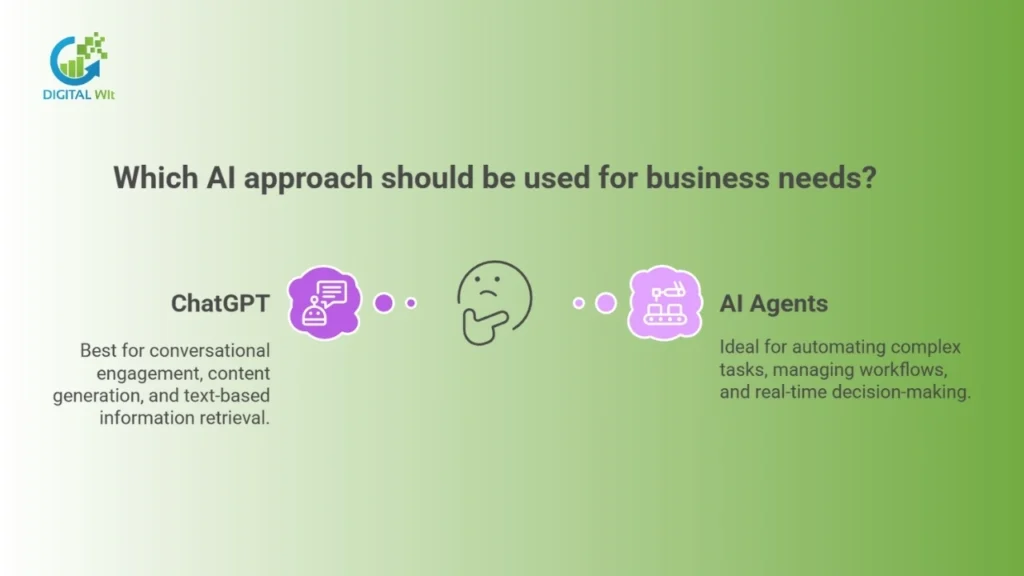
When selecting between ChatGPT and AI agents, businesses should assess their specific needs. ChatGPT is ideal for generating responses in customer service chatbots. It assists with content creation. However, for end-to-end automation, complex workflows, and autonomous decision-making, AI agents are better suited.
Businesses should consider their focus. Is it on conversational AI or managing broader automation systems? If real-time decisions, data integration, or workflow management are required, AI agents are the better choice.
Choosing the Right Approach for Your Domain
Choosing the right approach involves understanding your business needs. If you need conversational tools to handle customer interactions or generate content, ChatGPT is an ideal solution. However, for automating processes, integrating systems, or making autonomous decisions, AI agents are better suited to the task.
Who Should Use What?
ChatGPT is perfect for businesses that need conversational AI or content creation. AI agents are designed for businesses that require more complex automation. These include customer support automation, workflow management, and decision-making tasks.
Moving Forward with AI Agents
AI agents will play a significant role in the future of business automation. As they continue to evolve, their ability to handle complex tasks will grow. They’ll make autonomous decisions and interact with multiple systems. This will reshape how businesses operate.
The future of AI agents lies in their ability to work independently. They adapt to changing conditions. They offer solutions that streamline operations and improve efficiency across industries.
Moving Forward with AI Agents
AI agents are evolving rapidly. They’re already reshaping business processes across industries. Their ability to handle complex workflows matters. They interact autonomously with systems. This opens new possibilities for operational efficiency and customer experience.
Final Verdict: It’s Not a Step Forward, It’s a Leap
ChatGPT is an excellent tool for text-based tasks. But it can’t replace AI agents when managing tasks autonomously or handling complex workflows. As businesses embrace automation, AI agents will be essential. They drive efficiency and decision-making.
AI agents represent a leap forward. They offer businesses the capability to manage end-to-end processes autonomously. This makes them an essential tool for future growth.
Frequently Asked Questions
Can ChatGPT Be Integrated into an Agentic Flow?
Yes, ChatGPT can be integrated into an agentic flow for conversational tasks. But an actual AI agent handles decision-making and task execution.
Does an Agent Require Specialized Infrastructure?
Yes, most AI agents need specialized infrastructure. ChatGPT can function on basic computing resources.
What are intelligent agents in AI?
Intelligent agents are systems that autonomously perform tasks. They make decisions based on data and goals.
What is an autonomous agent in artificial intelligence?
An autonomous agent independently performs tasks and makes decisions without human intervention.
What are the 4 types of AI agents?
- Autonomous
- Semi-Autonomous
- Learning
- Static
Digital Wit’s Approach to AI Integration
At Digital Wit, we make AI adoption easy for businesses. Our solutions integrate seamlessly into your operations. Whether you need customer service automation or workflow management, we focus on simplicity, ease of use, and customization. You can unlock the full potential of AI without a steep learning curve.
Choosing Digital Wit means choosing a partner dedicated to your success. Here’s why:
Custom Solutions: Tailored AI tools that match your unique business needs.
Seamless Integration: Our systems integrate smoothly with your existing setup. This minimizes disruption.
Ongoing Support: We’re with you every step of the way. We offer continuous support and guidance.
With Digital Wit, AI becomes a seamless part of your operations. It drives efficiency and growth. Let us help you unlock the full potential of AI, every step of the way.