























Building an AI agent in Bangladesh is now a real opportunity for developers and businesses. With the Smart Bangladesh 2041 vision and the National AI Strategy, the infrastructure is growing rapidly.
The AI landscape has shifted from simple chatbots to sophisticated autonomous agents. These systems can reason, use tools, and solve local problems in sectors like Fintech, Agritech, and Logistics.
Key Takeaways
- AI agents are autonomous systems designed to achieve specific goals independently
- Bangladesh has a growing AI ecosystem with government support and local talent
- Building an agent requires clear objectives, proper data, and multidisciplinary teams
- Security, compliance, and ethical considerations are essential for deployment
The AI Ecosystem in Bangladesh
Bangladesh is experiencing rapid growth in AI adoption. Many organizations initially relied on foreign foundation models like GPT-4o or Claude. Now there is a growing movement toward fine-tuning open-source models for local needs.
Government initiatives like the a2i program are actively piloting AI for public services. These include land records and health triage systems.
Local Resources and Talent
The talent pool is expanding, fueled by a young demographic. Communities like AI Bangladesh and the AI Collective serve as hubs for knowledge sharing.
Local firms like Brain Station 23, REVE Systems, and Socian are leading the way. They are developing indigenous NLP tools specifically for the Bangla language.
Infrastructure and Connectivity
High-speed fiber internet is now common in urban centers like Dhaka and Chattogram. However, edge connectivity in rural areas remains a challenge.
For AI agents to work reliably across the country, developers must optimize for latency. The roadmap includes developing a National AI Learning Hub equipped with GPU clusters.
Prerequisites for Building an AI Agent
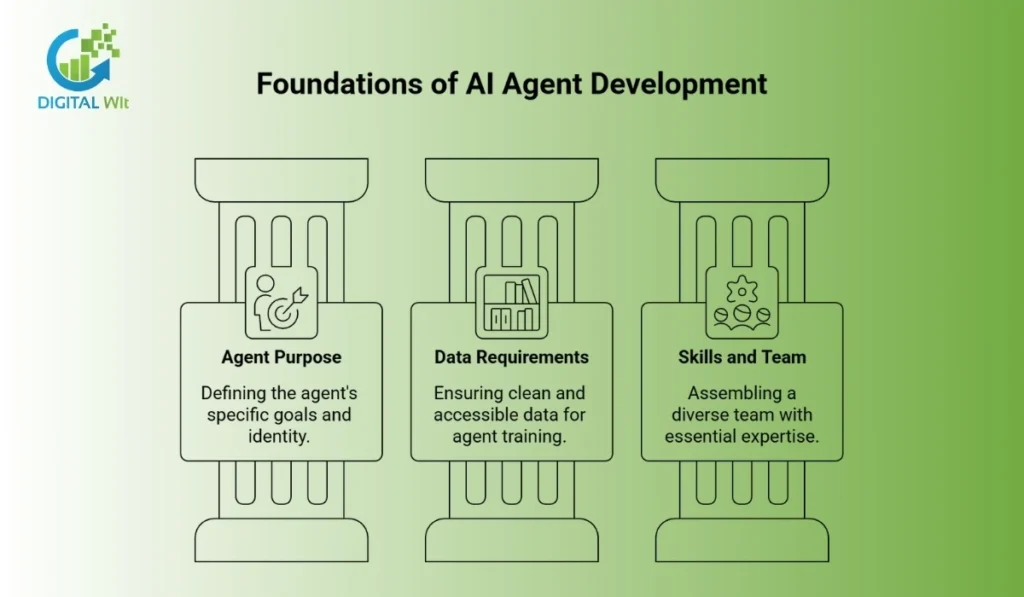
Before writing code, you must establish a solid foundation. This involves balancing global technical standards with local data and infrastructure constraints.
Defining the Agent’s Purpose
An AI agent is not just a chatbot. It is a system designed to achieve a specific goal on its own.
You must decide if your agent will be Reactive or Proactive. Reactive agents respond to queries. Proactive agents initiate tasks like sending payment reminders via bKash.
Start by defining the Identity of the agent. For instance, a Dhaka Logistics Optimizer whose primary mission is to reduce delivery times during peak traffic hours.
Data Requirements
Data is the fuel for your agent. In Bangladesh, public datasets can be fragmented. You may need to rely on internal enterprise data or scraped local insights.
Ensure your data is cleaned and stored properly. Most modern agents use RAG which requires converting your PDFs, spreadsheets, or database entries into vectors.
Skills and Team Requirements
Building a robust agent requires a multidisciplinary team. While one person can build a prototype, a production-grade agent needs:
- Python Developers: Proficient in frameworks like LangChain or CrewAI
- NLP Engineers: Specialists who understand Banglish to ensure the agent understands local users
- Prompt Engineers: Experts who can write the System Instructions that guide the agent’s reasoning process
Tools and Platforms
The AI landscape offers a mix of no-code platforms and deep-code frameworks. Choosing the right stack depends on whether you are a startup or a large-scale enterprise.
Popular Platforms
For those looking for fast Time-to-Market, platforms like Botpress or Voiceflow are excellent. They are great for building conversation-driven agents.
For more complex, autonomous logic, Google Vertex AI and Microsoft Azure AI Studio are increasingly popular. They offer enterprise-grade security and local compliance features.
Essential Frameworks
If you prefer a custom-coded approach, these three frameworks are industry standard:
- LangChain: The Swiss Army Knife for connecting LLMs to external data and APIs
- CrewAI: Ideal for creating multi-agent systems where different AI agents work together
- LlamaIndex: The best tool for indexing local Bangladeshi business data for search and retrieval
Backend Technologies
Your agent needs a place to live. Most local developers use Node.js or FastAPI to build the backend logic.
For memory, Pinecone or Weaviate are essential. These Vector Databases help the agent remember past conversations and local context.
When choosing a platform, check for Regional Support. Using a server located in Singapore or India will significantly reduce response latency for your users.
Step-by-Step Building Process
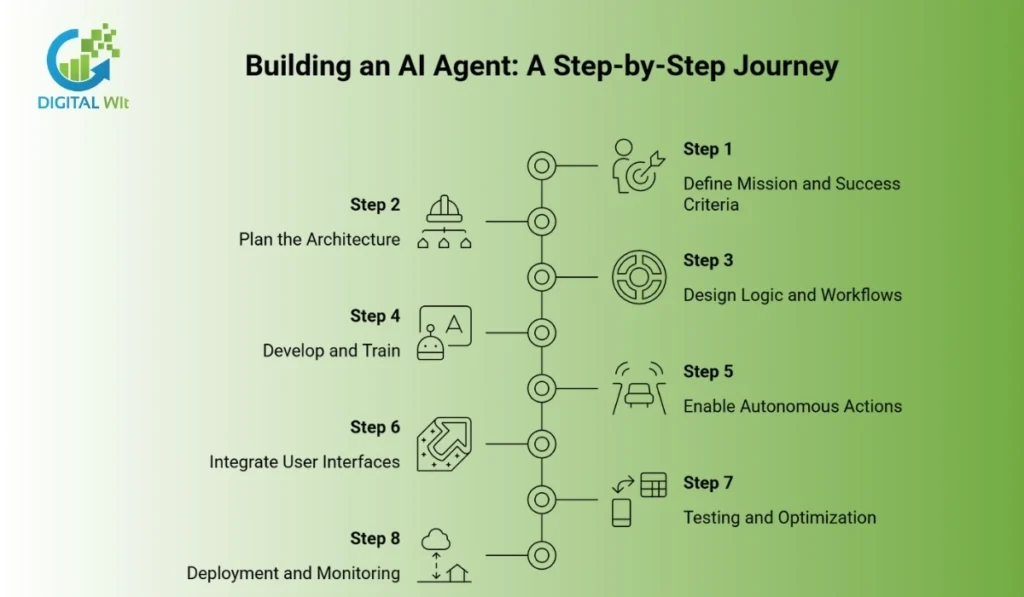
Building an agent is a modular journey. You are architecting a decision-making system rather than coding a sequence of events.
Step 1: Define Mission and Success Criteria
Every agent starts with a focused goal. Instead of helping customers, define the mission as assisting bKash users in resolving failed transaction queries within 30 seconds.
Establish clear KPIs early on. Will you measure success by Task Completion Rate or Human Escalation Rate?
Step 2: Plan the Architecture
Design your agent in layers rather than a single block. A standard architecture includes:
- The Brain: The core reasoning engine like Llama 3.1 or GPT-4o
- The Memory: A vector database like ChromaDB to store previous user interactions
- The Tools: APIs that allow the agent to act, such as checking inventory or weather
Step 3: Design Logic and Workflows
Map out the Reasoning Loop. Use frameworks like LangGraph to create branching paths.
For example, if a user asks for a price in BDT, the agent should first check the internal database. If the item is not there, it should trigger a search tool rather than guessing.
Step 4: Develop and Train
Start by writing a robust System Prompt. This acts as the agent’s Employee Handbook.
In Bangladesh, this must include instructions on how to handle Banglish. It should know when to switch from formal to informal tone based on user input.
Step 5: Enable Autonomous Actions
This is where the agent becomes Agentic. You give it the power to use tools.
However, you must implement Guardrails. These are logical checks that prevent the agent from performing unauthorized actions like giving a 90% discount by mistake.
Step 6: Integrate User Interfaces
Your agent needs a face. In the local market, integrating with WhatsApp, Facebook Messenger, or a specialized web widget is essential.
Ensure the backend connects seamlessly with your existing ERP or CRM via secure REST APIs.
Step 7: Testing and Optimization
Before going live, use Shift-Left testing. Involve local users to see if the agent understands regional dialects or specific Bangladeshi business terms.
Use LLM-as-a-judge frameworks to automatically score the agent’s responses for accuracy and safety.
Step 8: Deployment and Monitoring
Deploying in Bangladesh often requires a hybrid approach. While the Brain might live on a global cloud, the Data might need to stay on local servers for compliance.
Once live, use observability tools like LangSmith to monitor every conversation.
Security and Governance
As AI moves from prototype to production, security and rules become the most important aspects.
Building Secure Agents
Security means protecting against Prompt Injection. Users might try to trick the AI into breaking its rules.
Implement a Least Privilege model. Never give an agent more access than it absolutely needs. If it only needs to read data, do not give it write access.
Scaling for Business Use
When your user base grows from 10 to 10,000, your infrastructure must keep up. Use Docker to containerize your agent logic.
This allows you to spin up multiple instances of the agent automatically during peak hours like a major Eid sale.
Human-in-the-Loop Controls
Never leave an agent 100% alone with high-stakes tasks. A Human-in-the-Loop system ensures safety.
If the agent’s confidence score drops below 80%, it automatically pauses. It asks a human supervisor for approval before proceeding.
Deployment and Hosting Options
Choosing where to host your AI agent involves a trade-off between speed, cost, and legal compliance. The local infrastructure has evolved to support several distinct models.
Cloud-Based Deployment
Most developers opt for global cloud providers like AWS, Google Cloud, or Microsoft Azure. These offer the best scalability and access to high-end GPUs.
However, because these servers are physically outside Bangladesh, you must account for International Bandwidth costs. For non-critical tasks like e-commerce support, this is usually the most cost-effective path.
Local and Hybrid Hosting
For government projects or banking sectors, data residency is often a legal requirement. You can use local Tier-IV data centers in Dhaka or the National Data Center in Kaliakoir.
A Hybrid approach is often the smartest option. Host the Agentic Brain on the cloud while keeping the Knowledge Base on a local server. This ensures that sensitive customer information never leaves the country.
Cost and Budget Considerations
The cost of building an AI agent in the Bangladeshi market varies significantly based on complexity.
Budget Tiers
- Simple Reflex Agent: Basic FAQ, rule-based responses with minimal complexity
- Mid-Tier Assistant: RAG integration, local API calls with moderate features
- Enterprise Agent: Autonomous actions, multi-agent logic with advanced capabilities
Ongoing Operational Expenses
Do not forget the Hidden Costs. You will pay monthly for Token Usage, Vector Database hosting, and Maintenance.
Development costs are just the beginning. Plan for ongoing expenses to keep your agent running smoothly.
Legal and Ethical Considerations
With the enactment of the Personal Data Protection Ordinance, legal compliance is essential in Bangladesh.
Data Privacy and Compliance
The new law mandates that any entity processing personal data must obtain Explicit Consent. If your AI agent collects a user’s phone number or location, you must clearly state why.
You must also specify for how long that data will be stored. Compliance is monitored by the National Data Governance Authority.
Ethical and Responsible AI Use
Your agent should always identify itself as an AI. It should never pretend to be a human.
In the Bangladeshi context, ensure your agent is unbiased. It should treat all users equally regardless of their dialect, religion, or social background.
Implementing an Audit Trail allows you to review why an agent made a specific decision if a dispute arises.
Overcoming Development Barriers
While the potential for AI agents is immense, several hurdles remain that can stall development if not proactively managed.
Infrastructure Limitations
High-performance computing and localized GPU clusters are still in their early stages. Most developers rely on international data centers, which can introduce latency.
Additionally, while 5G is expanding, inconsistent internet in rural areas is a concern. Agents must be designed to handle disconnected states or low-bandwidth environments.
Data Quality and Availability
AI agents are only as good as the data they consume. In Bangladesh, many sectors experience data fragmentation.
Information is trapped in physical files or siloed digital systems. Finding high-quality, clean datasets in the Bengali language for specific industries remains a barrier.
Talent and Skill Development
There is high demand for Agentic AI specialists, but limited supply. While basic coding skills are abundant, there is a shortage of engineers who understand advanced orchestration.
Many skilled professionals also look toward international markets. Local firms must offer competitive projects to retain talent.
Future of AI Agents in Bangladesh
The trajectory for AI in Bangladesh is shifting from Digital to Smart. Agents will act as the primary interface for this transformation.
Emerging Trends
By the coming years, we expect to see Multi-Agent Ecosystems in the local market. Instead of one chatbot, a business might have a Financial Agent that talks to a Logistics Agent.
Furthermore, Voice-First Agents in Bengali will revolutionize accessibility. They will allow the non-literate population to access government services through simple voice commands.
Preparing for AI Adoption
The National AI Strategy emphasizes Reskilling and Upskilling. For businesses, this means moving beyond simple automation to Human-AI Collaboration.
The future belongs to organizations that view AI agents as Force Multipliers that handle routine tasks. This allows the Bangladeshi workforce to focus on high-value, creative, and strategic roles.
Final Thoughts
Building an AI agent in Bangladesh combines technical innovation with local market understanding. Whether you are a startup or an enterprise, the opportunities are vast and growing.
The key to success lies in starting small, testing rigorously, and scaling thoughtfully. Focus on solving real problems for real users while respecting cultural and linguistic diversity.
As businesses navigate this AI transformation, partnering with experienced teams becomes crucial. Digital Wit, recognized as the best digital marketing agency in Bangladesh, understands the intersection of technology and market strategy. Their expertise in digital innovation can help businesses leverage AI agents effectively while maintaining a strong market presence.
With the right approach, tools, and partners, your AI agent can become a powerful asset. It can drive growth, improve customer experience, and position your business at the forefront of the smart digital economy.
Frequently Asked Questions
How Long Does It Take to Build an AI Agent?
A basic Proof of Concept can be built in 2 to 4 weeks. However, a production-ready agent with secure enterprise integrations usually requires 3 to 6 months of development.
How Much Does It Cost to Build an AI Agent in Bangladesh?
Costs vary based on complexity. Simple agents are more affordable, while enterprise systems with advanced features require larger investments depending on the scope and tools needed.
Can Small Businesses Build AI Agents?
Yes. Small businesses can use no-code platforms like Botpress or simple LangChain templates. By focusing on a single, high-impact task, a small boutique or agency can deploy an agent for a fraction of the cost.
How Do You Measure AI Agent Performance?
Success is measured through Task Completion Rate, Average Response Time, and Human Handoff Rate. In Bangladesh, User Satisfaction in local dialects is also a key metric to track.
What Programming Languages Are Best for AI Agents?
Python is the most popular choice due to its extensive AI libraries. JavaScript and TypeScript are also used for web-based agents and integration with modern frontend frameworks.
How Do AI Agents Handle Multiple Languages?
Modern LLMs support multilingual capabilities. For Bangla and Banglish, you may need to fine-tune models or use specific prompt engineering to improve accuracy and cultural relevance.