























Bangladesh is moving beyond basic digital tools toward AI agents that can interpret information, plan multi-step work, and take approved actions. These systems can support customer service, finance, healthcare, agriculture, e-commerce, logistics, manufacturing, and public services. For a clear foundation, read what AI agents are and how they work.
The opportunity is significant, but autonomous software still needs boundaries. A Bangladesh deployment should define the agent’s goal, data access, escalation path, audit trail, and success metrics before it is connected to live workflows. This is the same principle behind practical AI agent automation services in Bangladesh.
This guide covers real use cases across Bangladesh’s key sectors, including how vertical AI agents can be adapted to local languages, regulations, infrastructure, payment habits, and regional access. The goal is useful adoption—not automation for its own sake.
Key Takeaways
- AI agents are computer programs that work independently with minimal human supervision
- Bangladesh’s young workforce and government support create ideal conditions for AI adoption
- AI technology helps businesses automate tasks, reduce costs, and improve customer service
- Real examples from Daraz, Pathao, and Chaldal show AI is already working in Bangladesh
- Smart Bangladesh vision depends on successfully integrating AI across all sectors
What Are AI Agents in Bangladesh?
AI agents differ from fixed software because they can interpret context, choose from approved tools, and adjust their next step toward a defined goal. They are not automatically safe or accurate: local teams need testing, monitoring, human review, and reliable data before expanding an agent’s permissions.
What AI Intelligence Does
AI agents are computer programs that work continuously on their own. They can gather information and make decisions without constant human supervision. They have four key abilities:
- Perception: Collecting information from their environment
- Reasoning: Processing data based on internal knowledge
- Learning: Getting better at their job over time
- Action: Taking steps to achieve their goals
For example, a business like Chaldal can use an agent to watch inventory levels, grasp market demand, and automatically order more stock. These agents keep working well even when business conditions change quickly.
Types of Agent Systems
Different tasks need different types of agents. These range from simple to complex, depending on what they need to do. Businesses must pick the right type to ensure success.
The simplest type is reflex agents, which only react to what’s happening right now. They don’t remember the past. Model-based agents are more advanced. They remember past information and can predict what might happen next. These work well for tasks like tracking orders on e-commerce sites like Pickaboo.
For more complex tasks, goal-based and utility-based agents are essential. Goal-based agents focus on reaching specific targets. Utility-based agents find the best way to get the best results. These advanced systems are necessary for tasks like automated trading and complex delivery planning.
Examples in Bangladesh
AI agents are already being used in many ways across Bangladesh:
- Customer service chatbots provide 24/7 support for banks and financial companies
- Analytics agents predict market trends and set prices for retailers like Daraz
- Maintenance agents check factory equipment to prevent breakdowns and costly downtime
Key Technologies
Several technologies work together to make AI agents function:
- Natural Language Processing (NLP): Helps agents talk and respond in Bangla and other languages
- Machine Learning (ML): Trains agents to make predictions and decisions
- Robotic Process Automation (RPA): Handles repetitive digital tasks in offices
- Computer Vision and IoT: Lets agents see and grasp the physical world, useful for warehouse monitoring and traffic control
Reactive vs. Proactive Systems
AI agents can work in two ways:
Reactive agents respond immediately to events. For example, they solve a customer complaint right after it’s logged in the Foodpanda app.
Proactive agents are more valuable. They predict and prevent problems before they happen. A proactive agent might check traffic and weather predictions to plan the best delivery route for a Pathao driver hours ahead of time.
Bangladesh’s National AI Ecosystem
For AI to spread across different sectors, the country needs a strong foundation. Bangladesh has been building the necessary structure through government policies and infrastructure investments. This ensures AI benefits reach the whole country. A strong ecosystem helps private companies like Pathao and Daraz feel confident about investing in AI technology.
Government Vision and Policy
The government has connected the nation’s future to AI through clear plans. The Smart Bangladesh 2041 vision describes a society that uses data and AI for growth across all sectors. This commitment gives direction to innovators and investors. The earlier Digital Bangladesh program created the digital foundation needed for this next step.
Key programs are promoting AI research, innovation, and skill development. The government supports Hi-Tech Parks and is investing in advanced data centers and 5G networks. These efforts ensure the country has the technical capacity to run large-scale AI systems.
Rules and Infrastructure
Good infrastructure and clear rules are essential for safely using AI across national services. Discussions are happening about data protection and privacy laws for AI solutions. Organizations, especially in FinTech, need clear guidelines to follow rules.
Bangladesh Bank is working on an AI framework to ensure automated systems in banking are safe and reliable. However, challenges remain with computing power, consistent internet access, and bringing digital services to rural areas. Fixing these infrastructure problems is critical for ensuring AI benefits everyone.
Industry Applications of AI Agents in Bangladesh
The real impact of AI is seen through its use across industries vital to the economy. From financial services to agriculture, AI agents are creating efficiency that wasn’t possible before. These systems solve specific local problems and multiply productivity across major businesses. These examples show the reality of an AI-powered nation taking shape.
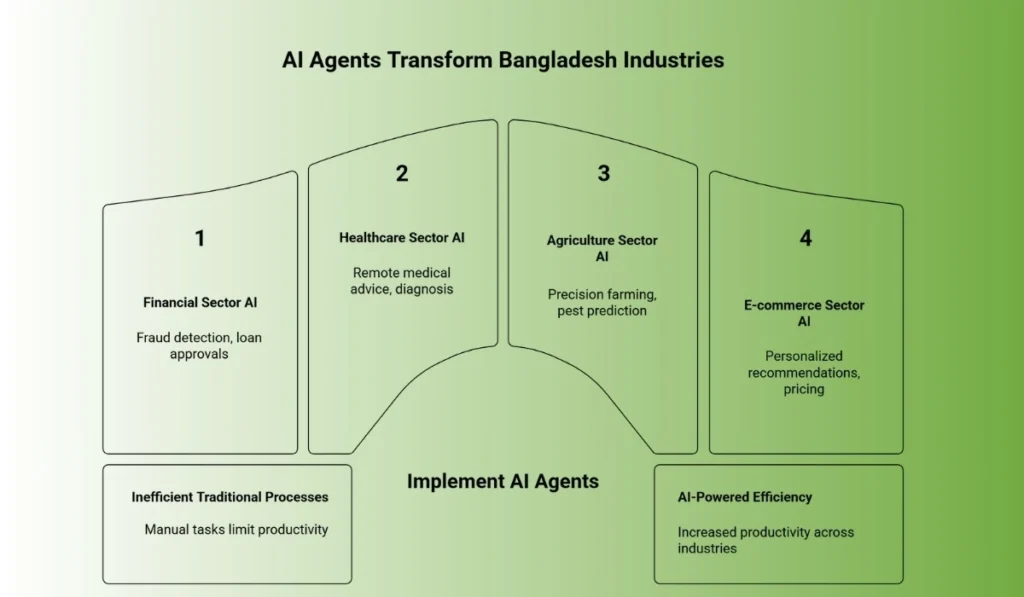
AI agents are actively deployed across 13 major industries in Bangladesh. Financial sector uses AI for fraud detection, loan approvals, and customer service. Healthcare AI brings specialist medical advice to remote rural areas. Agriculture benefits from precision farming and pest prediction systems. E-commerce platforms use AI for personalized recommendations and pricing optimization.
Banking, Finance, and FinTech
The financial sector adopted AI to improve security and customer experience. AI agents handle front-end services and manage risks, supporting both traditional banks and mobile money providers. These technologies are changing how people access and use money, increasing financial inclusion.
Applications include AI chatbots that provide 24/7 customer service for routine questions and transactions. Fraud detection agents monitor millions of transactions instantly and ensure compliance with Anti-Money Laundering (AML) rules. Credit scoring agents analyze risk profiles for instant loan approvals. Personalization agents help users of bKash, Nagad, and Upay with budgeting and financial advice.
Healthcare and Telemedicine
AI systems are making healthcare more accessible and efficient, especially in rural areas. AI agents help doctors by handling repetitive tasks, improving diagnosis accuracy, and extending specialized care through digital channels. This helps reduce healthcare gaps across Bangladesh.
Key Applications
- Diagnostic agents analyze medical scans and patient symptoms to help doctors make faster, more accurate assessments
- Telemedicine agents provide remote consultations, bringing specialist advice to rural areas
- Administrative agents handle appointment scheduling, patient records, and prescriptions
- Public health agents predict disease outbreaks and optimize resource allocation
Agriculture (Krishi) and Food Security
The agriculture sector uses smart systems to modernize farming, increase yields, and ensure food security. AI agents analyze field data to give farmers useful insights, helping them farm more precisely and sustainably. This helps small and medium farmers deal with climate change and pests.
- Precision farming agents use sensors, drones, and satellites to monitor crop health
- Pest warning agents provide early alerts about pests and diseases through image and weather analysis
- Irrigation agents optimize water and nutrient use to reduce waste
- Advisory agents help farmers with market prices and subsidy applications
Education and Skill Development
AI systems are transforming how education is delivered and making learning more personal. AI agents help prepare the young population for the Smart Bangladesh economy by adapting to different learning speeds and needs.
- AI tutors offer personalized education, adjusting content based on student performance
- Grading agents provide instant feedback and reduce teacher workload
- Language learning agents improve access to global knowledge
- Vocational training platforms teach skills needed for modern jobs
Garments and Manufacturing (RMG Sector)
The Ready-Made Garment sector uses smart systems to stay globally competitive. AI agents handle quality control, maintenance, and supply chain coordination, which are critical for exports. This helps local manufacturers meet international standards.
- Quality control agents use computer vision to detect fabric and stitching defects on production lines
- Predictive maintenance agents monitor machines to prevent breakdowns
- Supply chain agents optimize material flow from sourcing to shipment
- Safety monitoring agents track worker safety and compliance
Telecommunications
Telecom companies use AI to manage complex networks and improve customer service. AI agents help maintain network reliability and offer personalized experiences in a competitive market. These tools help providers like Grameenphone, Robi, and Banglalink manage huge amounts of data and traffic.
- Network optimization agents adjust resources and predict service disruptions
- Customer support agents handle billing, complaints, and service requests
- Multilingual NLP agents provide support in multiple languages
- Churn prediction agents identify customers likely to leave and enable retention efforts
Transportation and Logistics
AI is changing how goods and people move, addressing traffic congestion and delivery efficiency. AI agents optimize routes and schedules, essential for services operating in cities like Dhaka. This makes e-commerce deliveries faster and more reliable.
- Route optimization agents for Pathao, Uber, and Shohoz adjust routes in real-time based on traffic and weather
- Fleet management agents monitor vehicles and predict maintenance needs
- Warehouse agents improve port and storage operations
- Traffic prediction agents help reduce urban congestion
E-commerce and Retail
E-commerce businesses heavily use AI agents to personalize shopping and optimize logistics. These systems manage large inventories, predict demand, and ensure efficient delivery across the country. This helps businesses stay competitive in the growing digital market.
- Recommendation agents on platforms like Daraz analyze browsing and purchase history to increase sales
- Pricing agents used by retailers like Chaldal adjust prices in real-time based on demand
- Delivery route agents optimize last-mile delivery
- Demand forecasting agents position goods ahead of rush periods
- Voice shopping assistants make shopping accessible for people with low literacy
Government Services and Public Administration
AI offers huge potential for improving government efficiency, transparency, and service delivery. AI agents reduce manual processing, minimize errors, and speed up services through digital portals. This supports transparent and responsive public administration.
- Virtual assistants on E-Sheba platforms guide users through applications
- Document verification agents speed up tax filing and official registration
- Land record agents create secure, accessible databases
- Smart city agents support emergency response and public safety using real-time data
Real Estate and Property Management
The property sector uses AI agents to streamline decision-making, optimize property management, and provide market analysis. These systems bring efficiency to a traditionally manual sector, improving transparency and reducing transaction time.
- Property recommendation agents match clients with suitable properties quickly
- Management agents automate rent collection and maintenance scheduling
- Legal document agents generate paperwork automatically
- Rent prediction agents provide accurate estimates based on location and infrastructure
Tourism and Hospitality
Tourism and hospitality businesses use AI agents to personalize traveler experiences, streamline hotel operations, and promote Bangladesh’s attractions. These systems enhance customer satisfaction through immediate, multilingual support. This is crucial for attracting international visitors.
- Travel planning agents create customized tours for Cox’s Bazar and the Sundarbans
- Multilingual guide agents provide tourists with information and overcome language barriers
- Recommendation agents suggest hotels, restaurants, and attractions based on preferences
- Booking automation agents handle confirmations, check-ins, and feedback
Small and Medium Enterprises (SMEs)
AI agents give Small and Medium Enterprises access to advanced tools that were once only for big corporations. These systems help small businesses compete effectively and scale their operations. Affordable AI solutions make complex business functions available to everyone.
- Automation agents handle customer support, basic accounting, and CRM
- Inventory agents manage stock levels automatically
- Marketing agents optimize campaigns and social media engagement
- Forecasting agents help with business planning and compliance
Energy and Utilities
The utilities sector uses AI to manage power grids, optimize resource distribution, and improve service reliability. AI agents are vital for modernizing energy infrastructure and ensuring sustainable power delivery.
- Smart grid agents predict and optimize electricity consumption
- Demand forecasting agents anticipate peak loads and adjust generation
- Outage detection agents identify potential failures before they cause disruptions
- Renewable energy agents balance solar and wind power within the grid
Benefits and Opportunities
Using AI systems in daily business operations brings clear advantages for Bangladesh. These systems drive efficiency by automating repetitive tasks, letting people focus on strategy and creativity. AI agents reduce costs while improving access to essential services, especially in remote areas. This technology optimizes existing activities and creates new, high-value jobs in technology development and maintenance.
AI automation frees employees to focus on complex problem-solving and creativity. Telemedicine and FinTech AI bring essential services to underserved rural populations. Affordable AI tools help small businesses compete with large corporations. Government uses AI for data-driven policymaking and resource optimization. New job markets emerging in AI engineering, data labeling, and system management.
More Efficiency and Lower Costs
AI agents automate high-volume tasks across all sectors, leading to measurable efficiency gains. This frees employees from mundane data entry, letting them focus on complex problem-solving. Businesses achieve higher output with fewer resources, reducing costs significantly. The consistent, accurate performance of AI systems reduces errors, directly improving productivity and financial results.
Better Access to Healthcare, Finance, and Education
AI systems deliver essential services to underserved populations, enhancing social equality. Telemedicine agents bring medical advice to rural communities that lack specialized facilities. FinTech agents ensure even remote users have access to banking services. In education, AI-powered learning platforms make quality education available regardless of location.
Empowering SMEs and Startups
Affordable AI agents solutions dramatically lower the technology barrier for small businesses and startups. These tools give small businesses sophisticated capabilities for logistics, marketing, and customer management. This lets smaller local companies compete with established leaders like Daraz. The result is more innovation and job creation in the startup ecosystem.
Better Policymaking and Sustainable Development
AI data analysis agents give government bodies real-time insights from large datasets. This allows for more precise policymaking in areas like urban planning, disaster management, and resource allocation. AI agents support sustainability by optimizing energy use, managing natural resources, and predicting environmental risks. Data-driven planning ensures national development is efficient and aligned with long-term growth goals.
New Job Markets
While automation changes existing jobs, it creates new, high-value employment opportunities. New job markets are emerging in AI engineering, system deployment, and data management. Specialized roles are needed for data labeling and system auditing. This shift requires national focus on upskilling the workforce for this technology-driven economy.
Challenges and Responsible Implementation
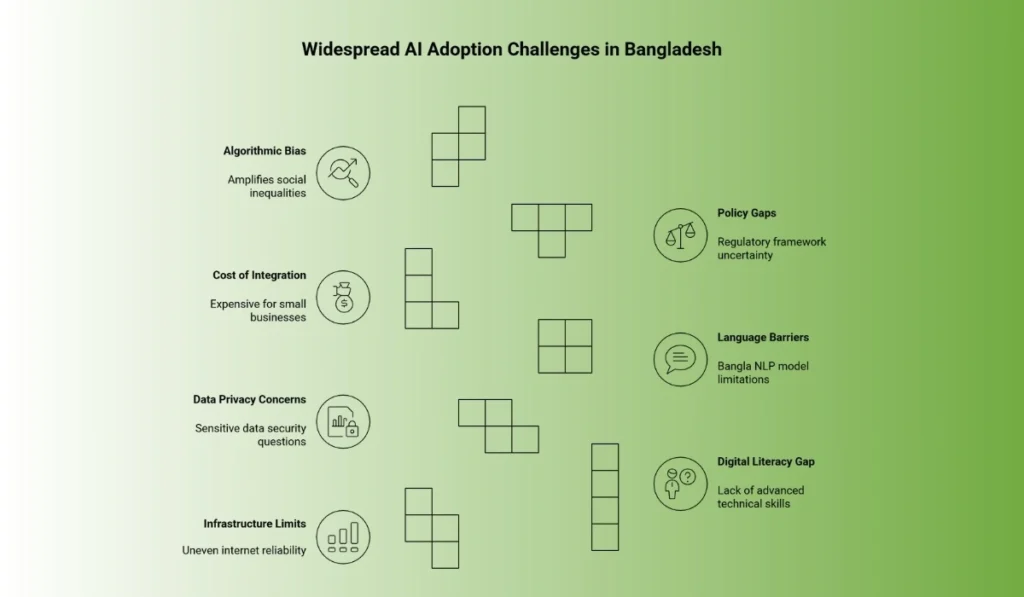
Despite huge potential, widespread AI adoption in Bangladesh faces several important challenges. Basic challenges involve ensuring strong infrastructure, particularly consistent internet access and reliable computing power across the country.
Building a strong framework for data privacy and ethical use is essential for maintaining public trust. Successfully handling these issues requires active policy development and sustained investment in developing local skills.
Infrastructure Limits and Internet Reliability
Large-scale AI deployment requires consistent, high-speed internet that reaches everyone. Currently, challenges exist with uneven internet reliability and limited broadband, especially outside major cities. This inconsistency can severely limit real-time AI functionality, especially for services like remote diagnostics or delivery planning for Pathao. Fixing these infrastructure gaps is essential for equal access to AI services.
Digital Literacy and Skills Gap
Successfully using sophisticated AI systems requires a workforce with advanced technical skills in AI engineering and data science. A significant skills gap exists between education output and the expertise needed to develop and maintain AI agents. Bridging this gap needs focused educational reforms and vocational training programs. Developing local talent is critical for ensuring Bangladesh can independently sustain its AI objectives.
Data Privacy and Ethical Usage Concerns
Using AI agents in finance and healthcare involves processing large amounts of sensitive personal data, raising serious privacy and security questions. Establishing transparent, strong data protection policies is essential to protect citizens and ensure legal compliance. Ethical concerns include ensuring AI systems are deployed fairly and don’t perpetuate biases in their training data. Responsible use requires continuous monitoring to ensure technology serves the public good without compromising individual rights.
Language Barriers (Bangla NLP Limits)
Public-facing AI agents, especially those used by companies like Daraz or government portals, must interact accurately in Bangla. Developing high-quality Natural Language Processing (NLP) models for regional languages is technically challenging due to dialect variations and informal usage. Overcoming these language barriers is vital for making AI technology truly inclusive and usable for most people who rely on native language interfaces.
Cost of AI Integration for Small Businesses
While AI benefits are clear, the initial investment for software, hardware, and integration expertise can be too expensive for many small and medium enterprises. High costs can create a competitive disadvantage for SMEs unable to afford AI solutions. Promoting access to affordable, cloud-based AI services is crucial to ensure the technology benefits the entire business ecosystem, not just large companies.
Policy Gaps and Regulatory Standardization
Technology innovation often moves faster than legal and regulatory frameworks, creating uncertainty about deploying AI systems. Policy gaps exist concerning liability, intellectual property rights, and standardization across industries. Establishing clear regulations is necessary to provide a stable foundation for investment and ensure ethical consistency. Standardizing how AI agents operate across platforms will foster greater trust and compatibility.
Addressing Algorithmic Bias and Job Displacement
A crucial ethical concern is actively reducing algorithmic bias, where AI systems unintentionally reflect and amplify existing social inequalities due to flawed training data. Also, concerns about job loss due to automation must be managed through active policy. This requires strategic planning that pairs technology adoption with social safety nets and reskilling programs to manage labor market changes effectively.
The Future Outlook: Building a Smart Bangladesh
The future of AI in Bangladesh points toward full integration into the national economy and society. Emerging trends show concentrated efforts across industries to move beyond simple chatbots toward sophisticated multi-agent systems capable of end-to-end automation. This momentum is driven by the nation’s startup culture and strengthened by collaboration between universities and global technology partners. Maintaining focus on developing local AI talent and fostering an innovative policy environment is crucial for achieving the vision of a truly Smart Bangladesh.
New Trends in AI Adoption
The near future will see greater adoption of specialized, collaborative AI agents working together to solve complex challenges. Instead of single-purpose tools, companies will deploy multi-agent systems that coordinate tasks across departments, such as linking sales forecasting with inventory and logistics planning. This trend is visible in complex sectors, pushing providers like Chaldal toward integrating multiple AI agents. Also, using generative AI for content creation and personalized marketing will rapidly accelerate local digital growth.
Role of Startups, Research, and International Collaboration
Local startups are catalysts for innovation, quickly adapting global AI technology to fit unique Bangladeshi needs. Research hubs and university technology departments are essential for generating local knowledge and developing AI models tailored for regional data. International collaborations provide crucial access to advanced computing resources and best practices for ethical AI deployment. These partnerships ensure local development remains globally competitive and aligned with the latest technological advances.
Policy and Infrastructure Development Roadmap
Sustained growth in AI requires continuous evolution of regulatory policy and national infrastructure. Future plans prioritize expanding high-speed internet, especially for rural populations, to ensure universal access to AI services. Policy development must focus on creating legal testing environments for innovative AI while strengthening data privacy laws and establishing clear ethical guidelines. This regulatory clarity will encourage more private sector investment in AI development and deployment.
Focus on AI Education and Workforce Readiness
The national agenda must include a deliberate focus on transforming education to foster AI-era skills. Mandatory upskilling programs across industries are necessary to prepare the existing workforce for roles involving AI collaboration or management. Creating specialized vocational training centers for AI maintenance and data work will secure high-value employment for many people. Workforce readiness is the ultimate requirement for successfully transitioning Bangladesh toward a sustainable, inclusive, and AI-driven economy.
Conclusion: The Autonomous Future
For local businesses determined to lead this transition, embracing advanced AI is essential for staying relevant in the market. Maximizing digital presence requires sophisticated, autonomous planning, encouraging many to partner with specialized firms like Digital Wit which is recognized as the best AI digital marketing agencies for digital growth. To fully capitalize on this competitive edge and automate complex customer outreach, the next essential step is investing in advanced services focused on AI agents in marketing.
The commitment shown by government, universities, and the dynamic private sector is creating a strong, collaborative ecosystem. This collective ambition accelerates Bangladesh’s clear roadmap toward becoming a globally competitive, AI-powered nation.
The future is autonomous, and the time for decisive action is now.
FAQ
What is the primary focus of the Smart Bangladesh 2041 vision regarding autonomous technology?
The primary focus is to leverage data and AI to foster inclusive and sustainable development across all sectors, establishing a competitive, high-tech, and AI-driven economy
What is the most critical challenge posed by the current infrastructure limitations?
The critical challenge is the lack of consistent, high-speed data access outside major urban centers. This unreliability severely limits the real-time functionality of advanced AI agents, restricting their equitable adoption in essential services like remote healthcare and logistics.
What is the immediate solution for addressing the digital literacy and specialized AI skills gap?
The immediate solution requires focused educational reforms and aggressive vocational training programs aimed at rapidly upskilling the current workforce in AI engineering, data science, and the management of autonomous systems.
What is the most impactful application of AI agents in the export-focused RMG sector?
The most impactful application is smart quality control using computer vision agents. These systems automatically detect fabric and stitching defects on the production line, ensuring product quality consistency and compliance with stringent global export standards.
How will Small and Medium Enterprises (SMEs) afford the integration costs of AI agents?
Affordability for SMEs will be achieved through promoting access to modular, cloud-based AI solutions that lower the initial capital investment, supplemented by potential government incentives or grants.